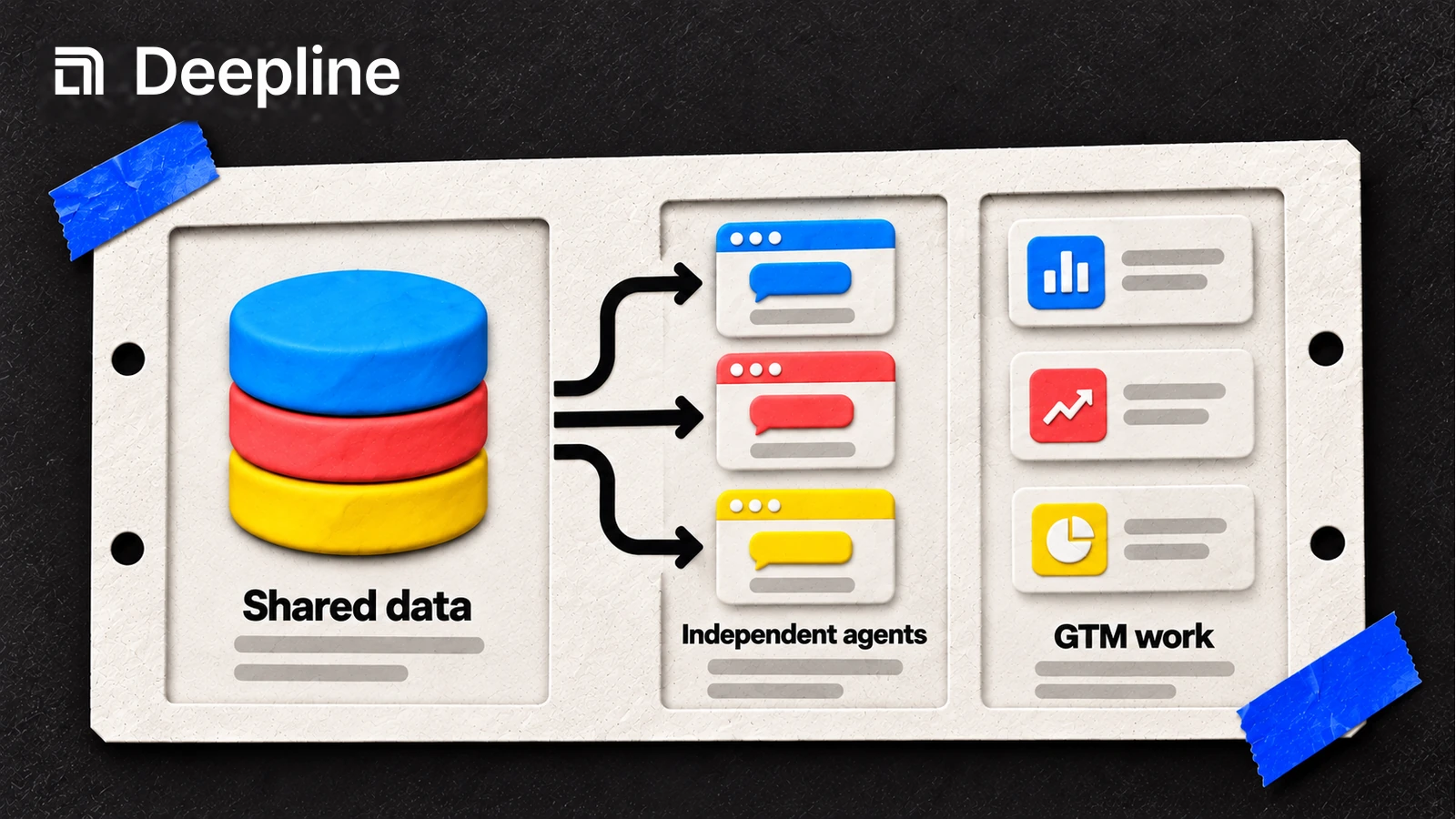
Six GTM teams walked on stage at Ramp HQ and, without coordinating, described the same architecture. Centralize the data and context once. Let a swarm of decentralized agents find the route and take the action. Keep humans in the loop for judgment, not for data plumbing. Chris Prinz from Modal said it in five words: "centralize the data and decentralize the agents."
Deepline hosted the GTM + AI NYC Lightning Talks at Ramp HQ in New York on June 30, 2026. Six talks, 91 minutes, speakers from OpenAI, Ramp, Notion, Modal, Attention, and Deepline.
The lineups at these events usually feel scattered. This one did not. Every speaker built their own version of the same idea. Nobody pitched a monolith. Everybody described a shared, trusted data layer that individual reps, or their coding agents, build bespoke workflows on top of. Julia from Notion called it "raise the tide for all ships" while still letting each rep build the motion that is specific to them.
The second move showed up in every talk too. You no longer guess the best tool or the best route. You show the system what "good" looks like and let it test its way there. What used to be a four-week data-science project is now a 30-minute eval loop. The hard part is no longer doing the work. It is defining the target and trusting the data going in.
What to take away
The shared principles, then one line per speaker:
- Centralize the data, decentralize the agents. Build one trusted data and context layer. Let reps and their agents build their own workflows on top of it.
- Define what good looks like, then let the system find the route. Stop picking the tool up front. Show the system a sample of good outcomes and let it test its way there with evals and backtests.
- Composable stacks beat monoliths. State machines and batch pipelines beat brittle chains of agents triggering agents.
- Humans stay in the loop for judgment. The agent drafts and takes the action. The human approves. Accountability does not transfer to the agent.
- Jai (Deepline): show the model good outcomes, give it many options, and let it find the best data waterfall for you.
- Keyan (Ramp): a centralized app plus a decentralized MCP so 400 reps build their own tools and the best ones flow back to the center.
- Chris (Modal): centralize the data, decentralize the agents, and build a state machine, not a router.
- Julia (Notion): good context is the bottleneck, so build shared customer hubs and let AEs build agents on top.
- Bryant (OpenAI): find the highest-leverage points in a workflow, add determinism there, and keep accountability with the human.
- Jacob (Attention): match reps to buyers on real shared traits, then confirm the hunch against historical deal data.
Watch the full playlist
Watch all six talks on YouTube
Jai Toor, Deepline
"Your ideal data waterfall is unique to you." There is no single best data provider. It depends on your business, so you have to test it for yourself. Jai's argument was that you define the outcome, hand a coding agent a sample of good outcomes, and let it test dozens of providers until it recreates them. What used to take four weeks now takes 30 minutes.
"You define the outcome of what good looks like. You let the systems programmatically find the patterns."
He was honest about how far this goes: "I'm honestly like surprised it keeps working at this point." The trick is always the same. There is a public source and a private source, and you combine them in a way that is specific to you.
Video not loading in LinkedIn or your in-app browser? Watch it on YouTube.
Keyan Sarrafzadeh, Ramp
"How Ramp let 400 reps build their own custom GTM tools." Ramp runs a centralized app plus a decentralized MCP so 300 to 400 reps can build on shared, permissioned data, and the best workflows flow back to the center. The design goal Keyan named: "we want to empower everyone to build their own tooling / And then bring those learnings back / Into the centralized solution."
Two details stuck. Ramp only builds in-house when it is a competitive advantage. And every time an agent calls a tool through the MCP, it has to log a rationale for why. That turns real usage into product research at higher fidelity than shadowing reps. As Keyan put it, salespeople are the most rational users on earth because there is a direct link between their work and their paycheck.
Video not loading in LinkedIn or your in-app browser? Watch it on YouTube.
Chris Prinz, Modal
"How Modal built one GTM data pipeline to rule them all." Chris gave the cleanest statement of the night: "centralize the data and decentralize the agents." His second rule was "build a state machine not a router." Batch everything in one dbt project instead of wiring up a brittle chain of agents triggering agents. It is easier to build, debug, and understand.
He is a data-quality veteran ("which makes me very fun at dinner parties") and his warnings were practical. Always eyeball a random sample of 100 rows by hand. Compare providers on cost per strong fit, not cost per row. And treat the data going in as the thing that decides everything: "Garbage in and garbage out is what people say around machine learning systems. It's really the same here."
Video not loading in LinkedIn or your in-app browser? Watch it on YouTube.
Jai's Deepline talk referenced the same idea from the other direction, so Chris's pipeline talk and Jai's waterfall talk pair well.
Julia Biedry Gonzalez, Notion
"How Notion built customer hubs: one shared context layer for reps and GTM agents." Julia's line was "good context is the bottleneck for accurate fast and efficient agents." A central team builds the shared context layer, the customer hubs. AEs build their own agents on top. Rise the tide for all ships, but never try to anticipate every rep's unique motion.
Two ideas worth stealing. She syncs data ahead of inference so the agent is not burning tokens fetching at query time: "we're kind of like converting GPUs to CPUs here." And she treats the agent like a real teammate with real permissions: "you can literally think of it as another collaborator in notion, so it's like a person with a seat." Every summary claim gets cited back to the source record to keep trust high and hallucinations down.
Video not loading in LinkedIn or your in-app browser? Watch it on YouTube.
Bryant McCombs, OpenAI
"Run your GTM through Codex." Bryant runs his GTM work through Codex, including the day he brute-forced Salesforce with Codex and became the internal go-to for anything Salesforce. The real argument was about where to add determinism: "you have to find the highest leverage points in a workflow and figure out how do you add determinism to those." The blocker is rarely the model. It is the process mapping.
His durable-skill point was the sharpest line of the event: "regardless of how many agents you have running for you, ultimately it's you." You are always accountable for your work. So the pattern is draft-then-approve. "I don't want the signal, I want the action to have already taken place and then I want to know whether or not I should approve that action."
Video not loading in LinkedIn or your in-app browser? Watch it on YouTube.
Jacob Fleisher, Attention
"Routing leads on interests, not territory." Jacob started from a qualitative hunch: "at the end of the day what I've learned is people buy from people they like." He matched reps to buyers on real shared traits, then re-ran historical Salesforce data to prove it. One rep, Noah, has a UK passport and closes other geos at a higher rate when he happens to be a dual citizen. Jacob joined data across Salesforce, Attention, and Deepline and built it all in Claude Code, then embedded it into the live workflow. He says it lifted win rate 30% and cut time-to-close 25%.
He also gets the best cold open of the night, tying his buzzed head to the company's Series B: he told his CEO he would buzz his head if they raised, and the CEO said "no, when."
Video not loading in LinkedIn or your in-app browser? Watch it on YouTube.
The pattern
The interesting teams are not collecting tools. They centralize the data and context once, then let decentralized agents build on top. They define what good looks like and let the system find the route. And they keep a human accountable for the judgment calls.
If you want to build GTM systems this way, grab the Deepline CLI. One API, one SDK, one billing profile across 109+ integrations, and every enrichment logged to a database you own. It takes two minutes to set up, and code GTMASCODE at code.deepline.com gets you started.
Want the full talks? The GTM + AI NYC playlist has all six.