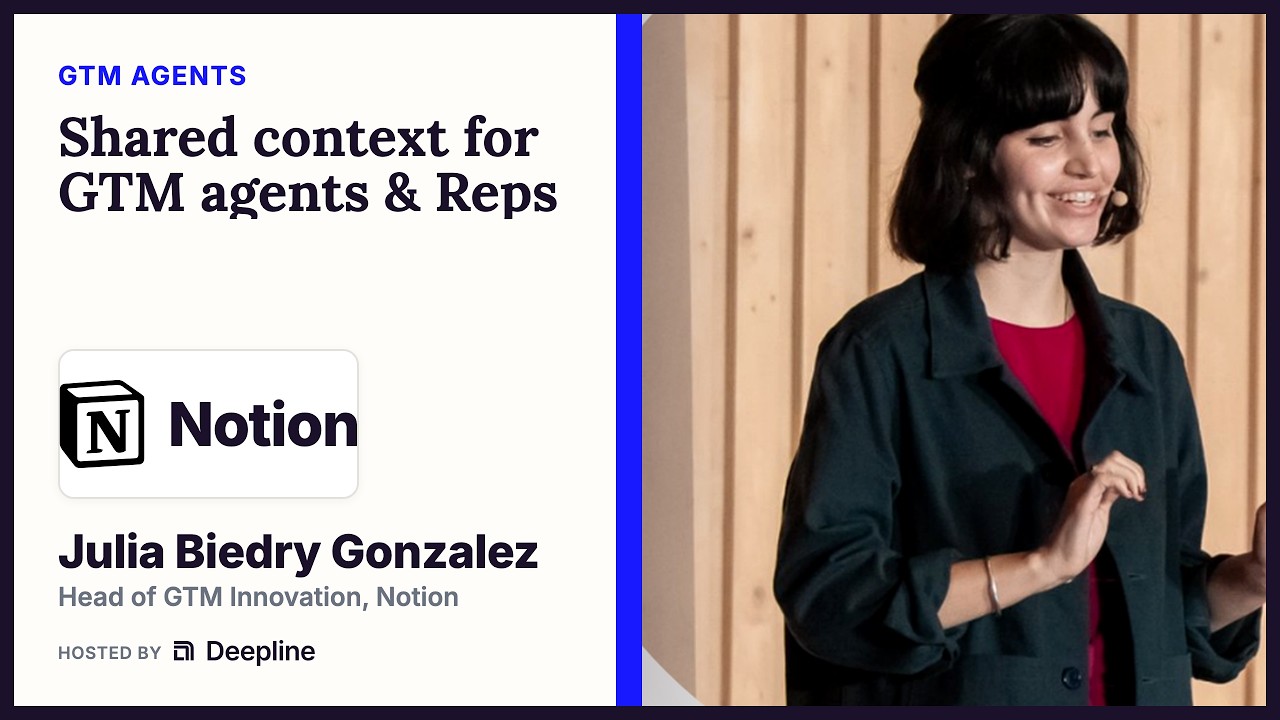
Context gets lost fast. Reps waste hours hunting for info across tools. The problem isn't missing features. It's that everyone is working from different scraps of data. At Notion, we wanted a single source of truth, so both humans and agents can build better workflows, faster.
Video not loading in LinkedIn or your in-app browser? Watch it on YouTube.
"The GTM stack is very complicated. We all know this. GTM has been strung together over the years out of tons of different vendors,"
Julia (head of GTM innovation at Notion) told the crowd at GTM + AI NYC Lightning Talks.
Every team sees its own version of reality. Sales, support, product, marketing, each with data scattered across CRMs, call transcripts, docs, and custom fields. Context slips through the cracks. Time gets wasted. The answer is to pull it all into what Notion calls customer hubs.
Build a shared context layer
The fix is straightforward. Sync structured and unstructured data, Salesforce, Gong, Zendesk, seller notes, product usage, into one place in Notion.
"This is basically a system of interrelated databases that are all keyed off of the customer ID."
Reps can add notes. Agents can summarize. Everyone works from the same hub.
Notion's developer platform made this possible. It has a feature called workers. Think of them as runtimes inside Notion that sync data or run custom code.
"Workers are basically a sandbox runtime inside of Notion that allows you to write and execute custom code. That's it. It allows you to do database syncs. It allows you to integrate Notion with whatever you want."
Now you don't have to chase down the latest data before a call or when running an agent. Everything's already synced. Agents can cite sources, so you know where info comes from. Grounding answers in cited context is one of the more reliable ways to cut down on hallucinations. Even non-technical people can edit context right in Notion. No GitHub, no hassle.
Flexible for every rep
Centralizing context doesn't mean forcing reps into one workflow. The base is shared, but reps and AEs can build custom agents or bring in outside playbooks. Each agent gets its own permissions and acts like a distinct team member, so an agent only touches what you explicitly give it access to. One AE imports outbounding tips from his favorite book and has his agent draft outreach messages. Another syncs industry news and has agents suggest prospects to target.
This saves time. It cuts errors. Everyone, including agents, is on the same page. The same context layer helps product and support spot patterns they'd miss otherwise.
If your GTM team is drowning in context chaos, look at how Notion builds customer hubs. Sync everything. Let agents and humans collaborate. Give reps freedom to build on top. It's not about making everyone work the same way. It's about making sure they're working from the same data.
Part of the GTM + AI NYC Lightning Talks - see all six talks. Hosted by Deepline at Ramp HQ.
Julia Biedry Gonzalez on LinkedIn · Notion
More from the event: Jai (Deepline) · Keyan (Ramp) · Bryant (OpenAI) · Chris (Modal) · Jacob (Attention)