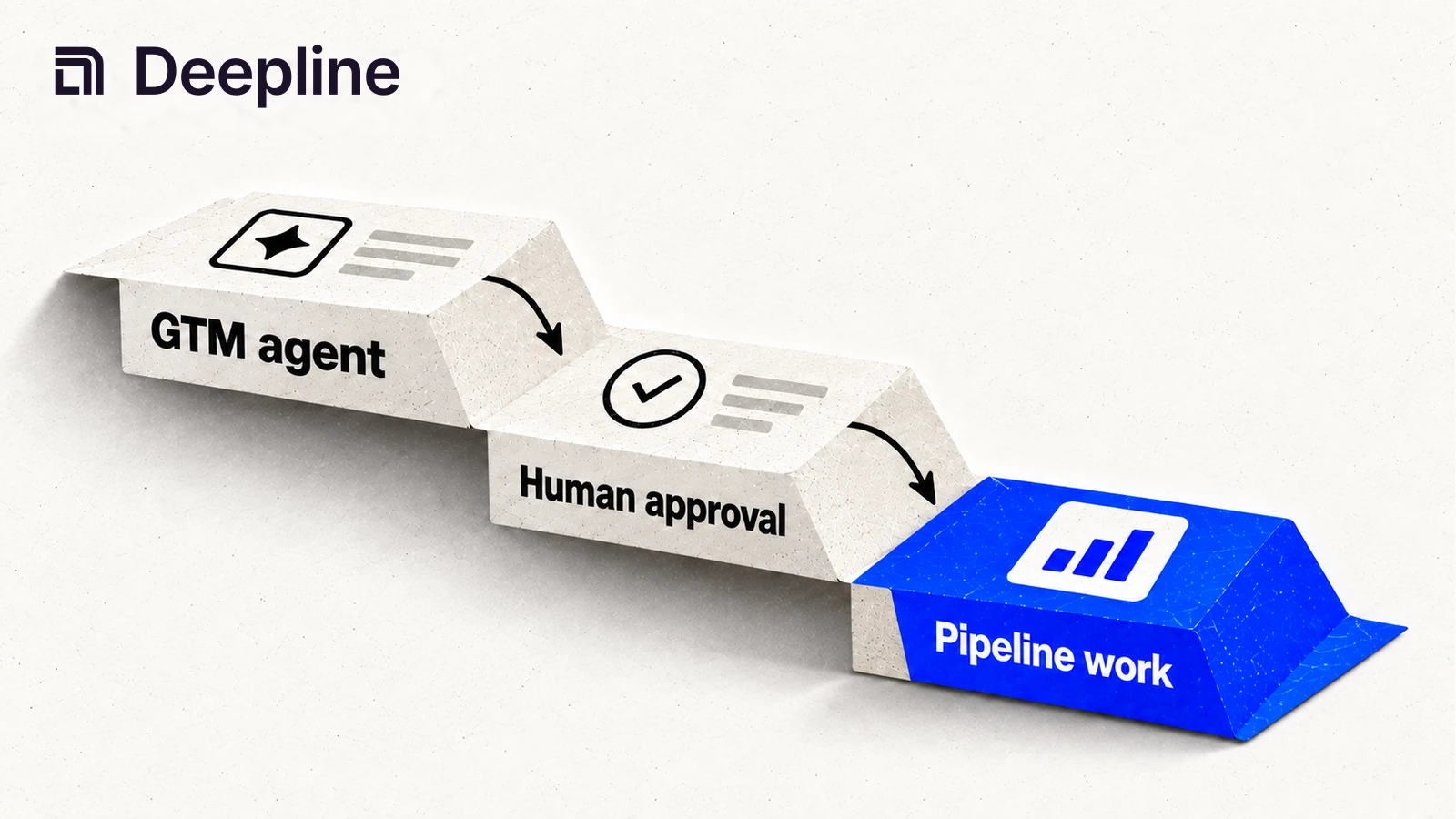
LangChain built their own GTM agent and it 3x'd their pipeline. Vishnu Suresh is bringing the full architecture to GTM as Code in San Francisco on June 9. RSVP at luma.com/46qf8eg3.
The talk: how LangChain 3x'd their pipeline with an agent they built themselves
| Metric | Result |
|---|---|
| Lead-to-qualified-opportunity conversion | +250% (Dec 2025 → Mar 2026) |
| Pipeline growth | 3x in same period |
| Time saved per rep per month | 40 hours |
| Agent runtime | DeepAgents (github.com/langchain-ai/deepagents) |
| Approval loop | Slack draft with reasoning visible |
| Learning mechanism | Per-rep style observations in Postgres |
Vishnu Suresh co-authored "How we built LangChain's GTM agent" — the most-read GTM engineering post of the first half of 2026. Harrison Chase called it out directly: "GTM agent built on top of deepagents."
The talk at GTM as Code SF will cover what actually went into building it, what broke, and the architecture decisions that made it work at LangChain's scale.
What the agent actually does
The agent triggers on every new Salesforce lead. It then:
- Checks whether to reach out at all (filters low-signal leads before spending any compute)
- Pulls Gong call transcripts for any prior contact history
- Scrapes the LinkedIn profile and runs web research on what the company is doing with AI
- Drafts a personalized outreach email with its reasoning and sources visible
- Posts the draft to Slack for the rep to approve, edit, or discard
The rep's edits are the interesting part. When a rep changes a draft, the system compares original vs revised, runs an LLM diff to extract style observations, and stores them keyed to that rep in Postgres. Every future draft for that rep reads those observations first. The agent gets better at writing for each individual rep over time without any explicit retraining.
Harrison Chase built a demo of this in under an hour. The community started rebuilding it open-source within two months.
DeepAgents + Railway: the deploy stack
DeepAgents (github.com/langchain-ai/deepagents) is LangChain's production agent harness — batteries included: planning, subagents, filesystem tools, auto-summarization, durable execution via LangGraph.
The examples/deploy-gtm-agent example in the repo coordinates:
- A sync market research subagent (blocks on results before strategy is written)
- An async content writing subagent (runs in the background, integrated when ready)
Railway is the deploy target: railway up, set your env vars, get a domain. Full TLS, automatic scaling.
We built our own version, deepline-gtm-agent, on the same architecture with Deepline's 109+-integration catalog available to checked Plays. It is open source.
Fork it: github.com/getaero-io/deepline-gtm-agent
The repo supports two paths:
- Managed Agent (recommended): Anthropic runs the agent loop and sandbox, your server is a thin broker
- LangGraph / DeepAgents: you run the agent loop on your own infrastructure, more control, more ops
RSVP
GTM as Code SF is June 9 in San Francisco.
RSVP: luma.com/46qf8eg3
Capacity is limited. Previous GTM as Code events sold out.
What's been built at past GTM as Code events
Read the full NYC recap · Hunter Rosenblume on RFP automation that cut his team from 5 to 2 · Nandika Jhunjhunwala on account scoring in 1 month instead of 12 · Nick Lafferty on marketing engineering and AI search · Kathleen Booth on competitive intelligence without a product marketer