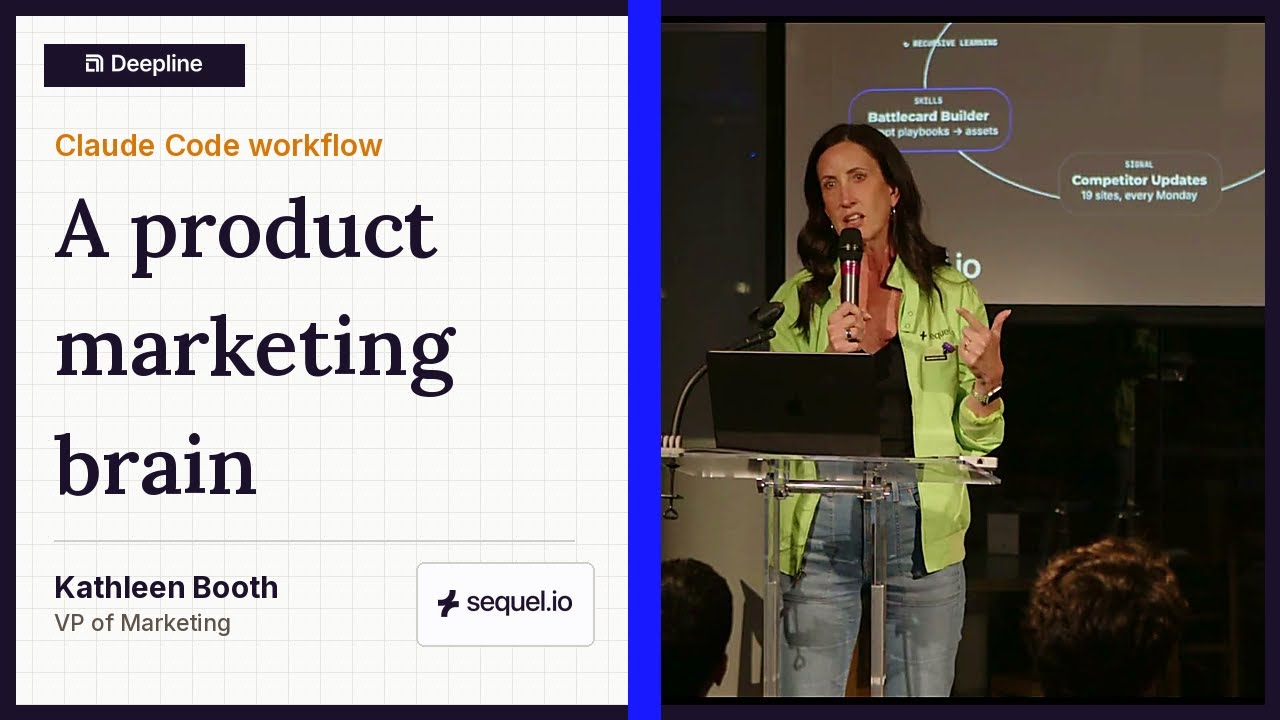
Kathleen Booth walked onto the GTM as Code stage and immediately flagged herself as the outlier in the room: non-technical, no GitHub repo three months ago, VP of Marketing. She then spent 20 minutes showing what she built anyway — competitive intelligence that self-updates weekly, battle cards for 19 competitors, and a product launch system that catches up to a 4-month backlog.
| Metric | Value |
|---|---|
| Competitors tracked | 19 |
| GitHub repo experience at time of build | 3 months |
| Product launches completed in December | 12 (12 days of shipping) |
| Days to catch up on backlog | ~60 days |
| Time from joining to first launch sprint | 30 days (onboarding) |
| Battle cards auto-generated | 19 (one per competitor) |
| Competitive scan frequency | Weekly (GitHub Actions) |
| Team size | 1 VP + demand gen + 2 BDRs |
Video not loading in LinkedIn or your in-app browser? Watch it on YouTube.
What to take away
- This is the most important talk in the room for non-technical people. Everyone else at GTM as Code had a GitHub repo. Kathleen got hers three months ago. She still built a system that handles competitive intelligence for 19 competitors, auto-generates battle cards, and runs product launches with no product marketer.
- Training documents are the foundation. ICP, personas, voice and tone, messaging, call transcripts, product recordings, CEO vision sessions — everything she fed the system made it smarter. The quality of the AI output is proportional to the quality of what you put in.
- Weekly competitive scans that update themselves. A weekly GitHub Actions run scans all 19 competitor blogs, news, and PR. Results post to Slack with source links. Competitor markdown files update automatically. Every week the system knows more.
- Atomize skills, don't try to do everything in one. Kathleen learned this the hard way. Single skills that tried to do everything failed. Separate each job into its own skill, orchestrate them together. That's the architecture that works.
- Persistent memory changes everything. She switched from Slack-first to Claude Code-first specifically for memory. The system remembers her preferences across conversations. She tells it what she doesn't like, it remembers. It gets smarter over time.
- The bookend strategy. Start by giving AI your point of view. Let it run. Review the output with a human in the loop at the end. Dialogue directly in Claude Code to correct inaccuracies. This is how she keeps the system calibrated as Sequel launches new things every week.
The situation: new product launches every week, no product marketer
Sequel.io is a webinar platform in a crowded market — Kathleen tracks 19 competitors. The product team ships constantly. Kathleen joined as VP of Marketing in November 2025 with a team of herself, a demand gen person, and two BDRs.
No product marketer. And when she arrived, four months of product launches that hadn't been announced yet.
"I joined November 1st and the goal was by Christmas to catch up. So, in the first 60 days."
She spent 30 days getting onboarded, then ran 12 days of shipping in December — a new product launch every day for 12 days leading into the holidays.
"It was insane and the only reason I could do it is because of AI."
The product marketing brain: architecture
The system has layers:
Training documents: ICP, personas, voice and tone, messaging framework, call transcripts, product recordings with the head of product, CEO vision sessions. She fed Claude everything she could find.
"Thank God for call recording."
Intelligence layer: Weekly competitive scans across all 19 competitors — product blogs, news, press coverage, M&A, funding. Started as a PDF emailed to herself. Now it's a Slack app that posts weekly with source links.
Competitor markdown files: After each scan, the system rewrites individual markdown files per competitor. They stay current and accumulate context. She also has a Sequel file tracking her own product.
Battle cards: Sales kept requesting them; she had 19 competitors and no product marketer. She built a skill that reads the markdown files, integrates with Google Drive, and generates Google Slide battle cards for each competitor. They update when new intel lands.
"Battle cards for all 19 competitors. They're pretty much self-updating for the most part."
Product launch skill: Takes a brief from the CPO, plus all the training documents, and generates everything needed for a launch: product brief, blog post, founder video script, sales enablement messaging, battle cards if needed, BDR outbound emails. Next step: stage those outbound emails directly to Apollo.
Why she moved everything to Claude Code
Kathleen started with a prompt chain in ChatGPT. She moved to Claude Code in February and credits it for making the system work.
Two things Claude Code gave her that Slack integrations and email notifications couldn't:
Persistent memory. The system remembers what she's talked about across conversations. She can tell it her preferences and it retains them. It gets smarter over time.
"I really wanted that. I wanted it to get smarter over time and have that memory."
Recursive learning. She can push back on results directly in the conversation. If something's wrong, she says so. Claude Code remembers the correction.
"If I see something inaccurate, I can be like, 'Hey, that's not right. Fix that.' And it will remember it from now on."
That's why she stopped routing outputs to Slack. You can't have a conversation with a Slack message.
The architecture lesson she learned the hard way
Early on, Kathleen tried to build single skills that could do everything. It didn't work.
"The thing I learned the hard way, which might be obvious to all of you who are more technical, is I tried to build single skills that could do everything. That did not work."
The solution: atomize. Each job gets its own skill. Competitive intelligence scan is one skill. Battle card generation is another. Product launch is another. An orchestrator coordinates them.
"They're working in concert, but they each have their own area of expertise."
The personal operating system she built this weekend
Kathleen mentioned in passing that she applied the same framework to her personal life over the previous weekend.
A weekly briefing runs in VS Code: scans all Granola meeting transcripts from the past week, pulls overdue and upcoming ClickUp tasks, reads email and calendar, generates a weekly brief. She can respond to it — "add items 1, 5, and 7 to ClickUp" — and it knows where to post them.
It runs on a chief of staff prompt she adapted from Kyle Poyar's newsletter, originally attributed to Justin Norris.
"It it literally is like having an executive mentor, and it gives me advice on how to communicate with my CEO, what to watch out for."
Instructions are in her Substack, Code Meets Creed.
The going-from-single-player-to-multiplayer problem
The best question from the audience: how do you teach someone on your team about a skill?
Her answer: AI show-and-tell as part of the weekly team meeting. Everyone shares one thing they did with AI that week. Can be as basic as "it helped me write an email." The point is exposure — seeing what's possible before you know what to build.
"I find at least as somebody who doesn't have an engineering background that the biggest limitation is like a failure of imagination. Just understanding what the tools are capable of."
She just hired a product marketer who's already extending the system, building a content marketing layer that updates blogs, tracks rankings, and generates pillar content from the same training documents Kathleen built.
What this means
If you're a non-technical marketer considering Claude Code, Kathleen's talk is the proof of concept. No GitHub repo 3 months before the talk. Built 19-competitor weekly intelligence, auto-generating battle cards, and a 12-days-of-shipping launch system. The barrier is imagination, not technical skill.
If you run marketing without a product marketer, this is the architecture: training documents as the AI's knowledge base (ICP, personas, voice/tone, call transcripts), weekly automated competitive scans as the intelligence layer, and atomized skills (one per job) coordinated by an orchestrator. Battle cards update themselves. Product launches generate themselves from a CPO brief.
If you're thinking about AI memory and learning over time, Claude Code's persistent memory is the reason Kathleen moved everything off Slack. You can't have a conversation with a Slack notification. The system gets smarter when you correct it in-context, and it remembers those corrections. That's compounding intelligence, not just automation.
Kathleen Booth on LinkedIn · kathleen-booth.com · Code Meets Creed on Substack · Sequel.io
Watch the full GTM as Code event · Hunter Rosenblume on RFP automation · Nandika Jhunjhunwala on account scoring for GTM agents · Nick Lafferty on marketing engineering and AI search