The Shift
GTM stacks are being rebuilt around agents
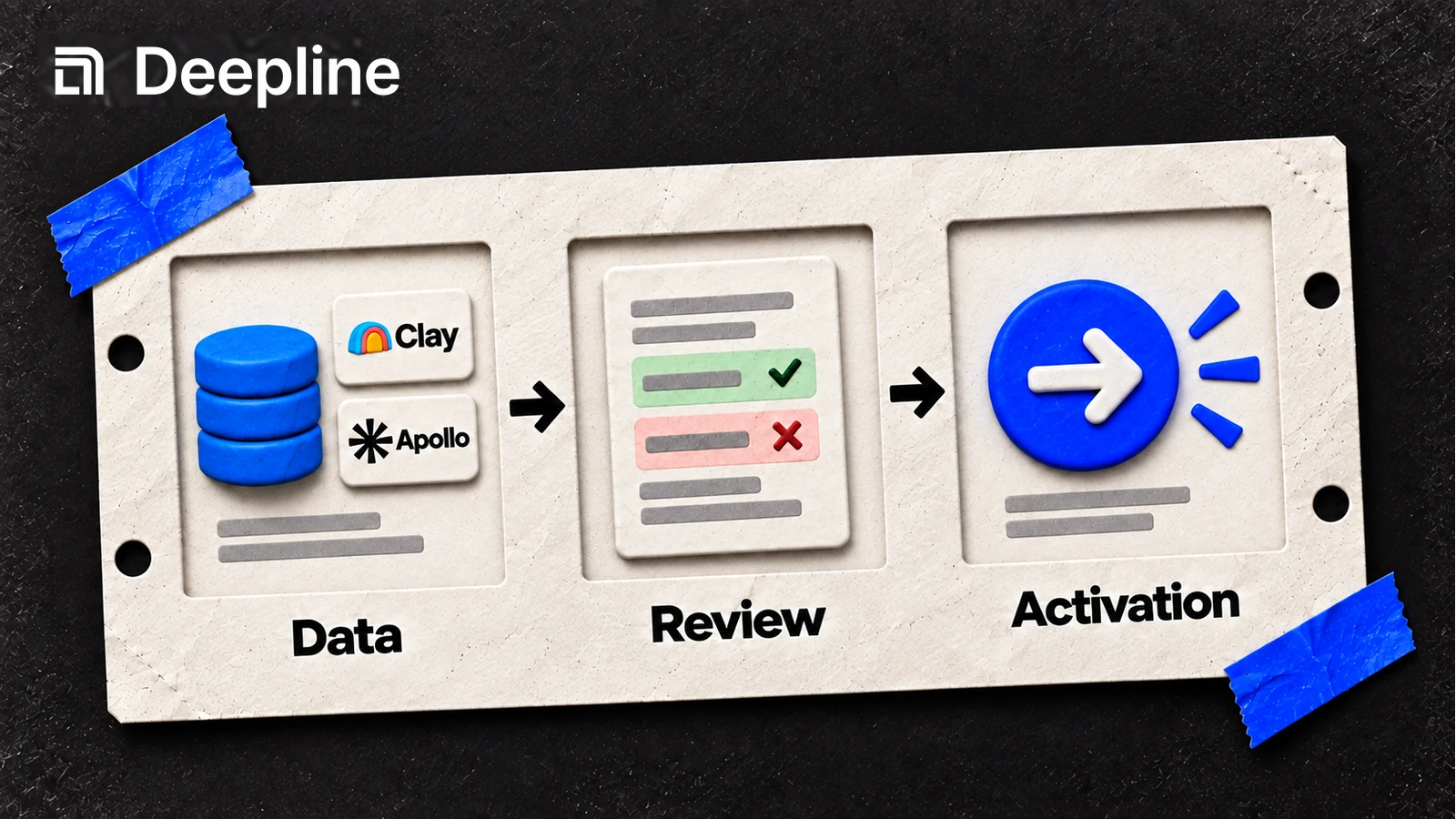
The GTM stack is moving from manual handoffs toward callable systems. Data providers, sequencers, and CRMs still do the underlying work. Coding agents can now coordinate those systems when they expose APIs, structured outputs, and clear approval boundaries.
Now, Claude Code can orchestrate the entire pipeline. Signal detection, enrichment, personalization, and outreach execution can all run from a terminal session. ColdIQ's post How Claude Code Builds an Entire Outbound Campaign in Under 20 Minutes is a concrete example of the workflow.
The question is not whether to automate GTM. It is which tools are agent-compatible and which become bottlenecks.
Ranking
Tool-by-tool comparison
| Tool | Category | Agent access | Operating model |
|---|---|---|---|
| Deepline | Enrichment orchestration | Native (CLI + API) | Managed usage or BYOK |
| Clay | Composable enrichment | Partial (API available) | Workspace and usage plans |
| Apollo | Prospecting + sequencing | Partial (API available) | Seat and usage plans |
| Outreach | Sales engagement | Limited (enterprise API) | Sales engagement contract |
| Salesloft | Sales engagement | Limited (enterprise API) | Sales engagement contract |
| HubSpot | CRM + marketing | Good (extensive API) | CRM suite tiers |
| Instantly | Cold email execution | API available | Sending plans |
| Lemlist | Multichannel outreach | API available | Seat plans |
The Full Workflow
From signal to sent: what agents need
A complete GTM workflow has five stages. Here is what each stage requires and which tools handle it.
1. Signal detection
Identifying that a company or person matches your ICP. This could be a job posting, funding round, tech stack change, or hiring signal.
Best tools: Apollo (job change alerts), HubSpot (website visitor tracking), Deepline (company enrichment to validate ICP fit).
An agent can monitor these signals automatically. Deepline's company enrichment fills in firmographic data so the agent can filter against your ICP criteria without manual review.
2. Contact enrichment
Finding the right person and their verified contact info. This is where coverage matters most.
Useful options: Deepline for callable multi-provider workflows, Clay for visual workflow building, and Apollo for an integrated prospecting database and sequencer.
This is Deepline's core. One command waterfalls through your configured email and phone providers:
PLAY_NAME=$(deepline plays search "verified work email waterfall" --json | jq -er 'first(.plays[] | select(.inputSchema.properties.csv? != null) | (.reference // .name))')
deepline describe "$PLAY_NAME"
deepline plays run "$PLAY_NAME" --csv signals.csv --watch
The waterfall queries providers in a configured order and can stop at the first result that passes validation. Measure verified-result rate and customer-visible Deepline usage per accepted result on your own ICP before choosing the provider order.
3. Research and personalization
Understanding the prospect well enough to write relevant outreach. Company news, tech stack, recent posts, mutual connections.
Useful options: Deepline for structured company data, Clay for operator-led research workflows, and Claude Code for synthesis inside a governed process.
This is where agents shine. Claude Code can take enriched data from Deepline and synthesize it into personalized talking points. No template variables. Actual personalization based on the prospect's context.
4. Sequence execution
Sending emails, LinkedIn messages, and follow-ups on a schedule.
Useful options: Instantly for email execution, Lemlist for multichannel workflows, Apollo for integrated prospecting and sequences, and Outreach or Salesloft for enterprise sales engagement.
Agents can prepare sequence changes through APIs. Keep the final send or activation behind an explicit approval unless the workflow has a separately reviewed automation policy.
5. CRM and pipeline management
Tracking responses, booking meetings, moving deals through stages.
Useful options: HubSpot, Salesforce, and Apollo all expose CRM or pipeline surfaces. The right choice depends on the system of record your team already operates.
HubSpot's API is extensive and well-documented. Claude Code can create deals, update stages, and log activities programmatically.
Tool Deep Dives
Deepline: the enrichment layer for agents
Deepline is not a replacement for every GTM system. It is a callable workflow and data layer that agents and applications use across 113+ integrations.
The Claude Code skill means an agent can run enrichment as part of a larger workflow without switching context. No browser tabs. No CSV exports. Just a command that returns structured data.
Deepline is the tool that makes natural language enrichment practical - the agent describes what it needs, Deepline handles the provider orchestration. The March 2026 r/ClaudeAI thread on prospecting with Claude Code + MCP and ColdIQ's post How Claude Code Builds an Entire Outbound Campaign in Under 20 Minutes both show the workflow directly.
Clay: visual enrichment for RevOps
Clay remains strong for teams that want a visual interface. The spreadsheet metaphor works well for RevOps operators who think in tables and filters. AI columns add intelligence without code.
Clay centers a visual table workflow and also offers API access. It fits teams that want humans to build and inspect enrichment logic in a workspace before automating it.
Apollo: integrated prospecting and sequencing
Apollo combines a prospecting database, enrichment, and sequence execution in one product. It fits teams that prefer a single managed system over composing several providers.
The tradeoff is provider choice. Test Apollo's data against your ICP and decide whether a separate multi-provider fallback is worth operating.
Instantly and Lemlist: sending infrastructure
Instantly focuses on cold email execution. Lemlist supports multichannel outreach. Both expose APIs that can sit behind an agent workflow.
Both have APIs that agents can operate. The key insight: separate your enrichment layer (Deepline) from your sending layer (Instantly/Lemlist). This gives you flexibility to swap either component.
Outreach and Salesloft: enterprise engagement
Outreach and Salesloft are sales-engagement systems for teams that need managed sequence execution, governance, and rep workflows. Confirm API availability and contract terms directly with each vendor.
Agent-Native Stack
The durable Claude Code + Deepline workflow
The durable artifact is not the chat transcript or generated script. It is a workflow with typed inputs, visible provider calls, validation rules, approval boundaries, and a run history.
| Stage | Durable output | Required control |
|---|---|---|
| Signal monitoring | Timestamped signal record | Source and freshness |
| Enrichment | Structured provider result | Validation and provenance |
| Research | Evidence-linked brief | Citation review |
| Personalization | Draft message | Human approval |
| Execution | Sequence or CRM mutation | Idempotency and audit log |
| Tracking | Outcome record | System-of-record reconciliation |
This matches the design direction in the DataFlow-Harness paper: agents become more useful when natural-language intent produces persistent, editable platform artifacts instead of disposable scripts.
Decision Matrix
Choosing your stack
| Team profile | Recommended operating model | Validate first |
|---|---|---|
| Solo founder | Integrated prospecting tool plus coding agent | Data coverage and send approval |
| Small technical GTM team | Deepline plus existing sequencer and CRM | Deepline usage per accepted result and replay |
| RevOps-led team | Visual workflow builder plus CRM | Operator speed and API handoff |
| Enterprise sales team | Deepline + Outreach/Salesloft + Salesforce | Governance, permissions, and auditability |
Price the stack with current vendor quotes and your expected usage. Compare completed workflow cost, not list-price units that measure different things.
Start with Deepline and your existing tools. Install the CLI, connect your provider API keys, and run a waterfall enrichment on your next outbound list. You do not need to rip and replace your entire stack at once.
FAQ
Frequently asked questions
1What is GTM automation?+
GTM (Go-To-Market) automation covers the tooling that helps revenue teams find prospects, enrich their data, personalize messaging, and execute outbound campaigns. In 2026, the best GTM stacks are increasingly agent-driven rather than manually operated.
2What is the best GTM automation tool in 2026?+
There is no universal best tool. Choose by workflow stage and operating model. Deepline exposes 113+ integrations to coding agents through callable workflows; visual builders suit operator-led work; sequencers suit sending; and CRMs remain the system of record.
3How does AI change GTM automation?+
AI agents can connect research, enrichment, drafting, and system updates when each tool exposes structured inputs and outputs. Irreversible actions such as sending outreach should still use explicit approval and audit boundaries.
4Is Apollo good enough for GTM automation?+
Apollo is a strong all-in-one platform for teams that want prospecting, enrichment, and sequencing in one tool. The limitation is that you are locked into Apollo's data. For teams wanting higher coverage through multi-provider enrichment, Deepline + a sequencing tool provides more flexibility.
5How much does a full GTM stack cost?+
Cost depends on seats, direct vendor contracts, sending infrastructure, CRM tier, and customer-visible Deepline usage. Compare current commercial terms separately, then measure Deepline usage per accepted result and completed workflow.
6Can Claude Code replace GTM tools?+
Claude Code is an orchestration layer, not a replacement for data providers or email infrastructure. Combined with Deepline for enrichment and a sending tool like Instantly or Lemlist, Claude Code can automate the workflow that previously required a RevOps team to manage manually.
7What is agent-native GTM?+
Agent-native GTM means the tools in your stack are designed to be operated by AI agents, not just humans. This requires CLI or API interfaces, structured inputs and outputs, and deterministic behavior. Deepline is built agent-native from day one.
8Should I use Clay or Deepline for GTM automation?+
Clay is better for teams that prefer visual workflow building and want a polished UI. Deepline is better for teams that want BYOK economics, agent-native execution, and CLI-first workflows. Both support multi-provider enrichment, but the pricing models differ significantly.
Related