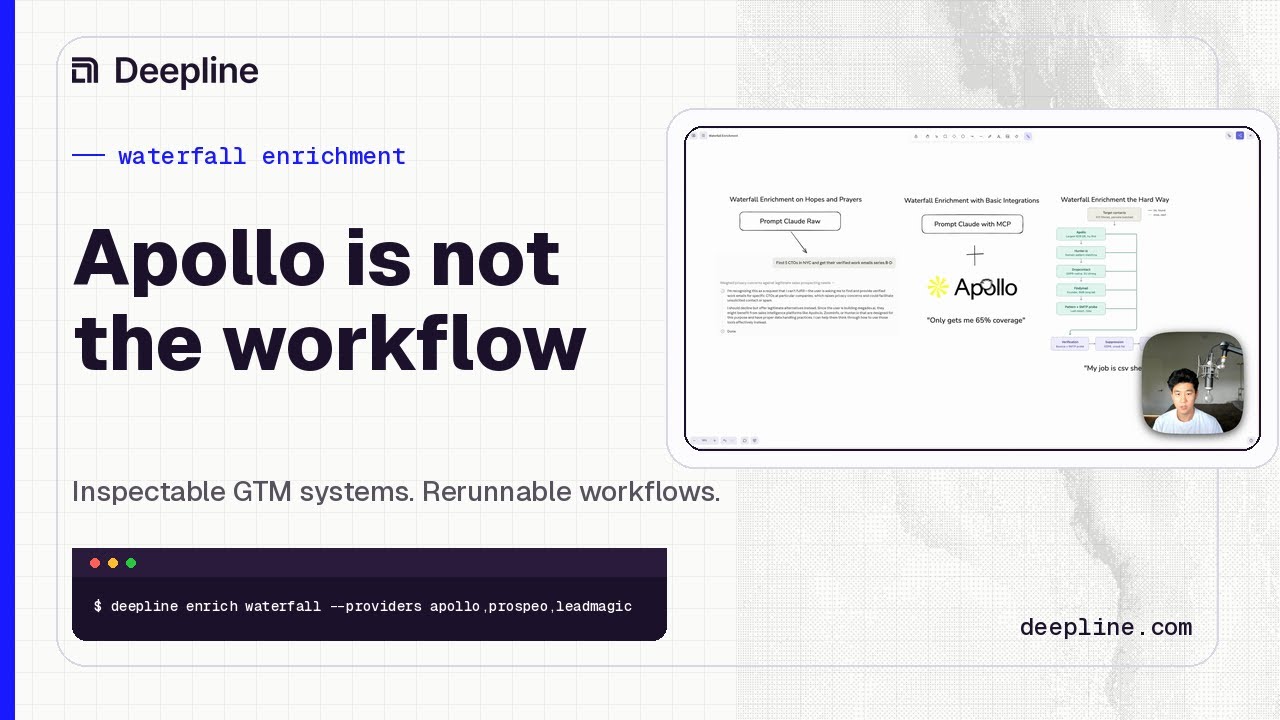
Video not loading in LinkedIn or your in-app browser? Watch it on YouTube.
Waterfall enrichment is the process of trying multiple data providers in sequence until you get the data you need. The hard part is not the provider. The hard part is preserving the logic, fallbacks, thresholds, and output quality without turning the whole thing into spreadsheet operations.
Direct answer
Waterfall enrichment is a workflow that tries multiple providers in sequence until a row is resolved. The useful system is not the one with the longest provider list. The useful system shows what happened, stops spending when it should, and returns a result the team can trust.
Apollo is useful. Apollo is not the workflow.
Apollo gives you one slice. Prospeo gives another. LeadMagic gives another. Then someone exports CSVs, dedupes rows, checks confidence scores, pastes a few columns back into the CRM, and calls it a workflow because everyone is too tired to argue.
That person is usually the growth engineer, or the technical BDR trying to become one.
What the video shows
Sung walks through the shape of a real enrichment waterfall:
- start with an account or contact list
- try the first enrichment source
- route failed or low-confidence records to the next provider
- preserve which provider returned which result
- keep enough structure that the workflow can be rerun, debugged, and improved
The important shift is moving from "I manually waterfall vendors" to "the waterfall is encoded as a repeatable system."
The old way
The old way looks harmless until it becomes the company process:
- export from Apollo
- export from another enrichment tool
- manually compare columns
- ask which email is more right
- import into HubSpot, Salesforce, Instantly, or an intermediate table
- repeat it next week with slightly different logic
This feels fast the first time. It becomes expensive the moment it matters.
The better way
A better enrichment workflow makes the decisions explicit:
- Which provider runs first?
- What counts as a usable result?
- What happens when a field is missing?
- What gets written back?
- What should never be overwritten?
- What evidence should be kept for auditability?
That is the job Deepline is trying to make natural for GTM engineers.
Video chapters
| Time | Chapter |
|---|---|
| 00:00 | Why one provider is not the workflow |
| 00:36 | Coverage gaps and fallback providers |
| 00:58 | Cost visibility before enrichment |
| 01:18 | The Deepline workflow |
| 02:38 | Approval before paid enrichment |
| 02:48 | Inspecting the waterfall |
| 03:21 | Final CSV output |
Search terms this page targets
- waterfall enrichment workflow
- Apollo enrichment workflow
- email enrichment waterfall
- GTM engineering enrichment
- growth engineering outbound workflow
- sales data enrichment workflow
FAQ
What is the difference between enrichment and waterfall enrichment?
Enrichment calls a data source to add missing fields. Waterfall enrichment calls multiple sources in sequence and stops when the row has a valid result.
Why not just use Apollo?
Apollo can be useful. The workflow around Apollo is the issue: misses, fallback providers, cost visibility, verification, and output inspection.
What should a GTM engineer care about most?
Auditability. If a lead makes it into a campaign, someone should be able to answer which provider found it, what the waterfall tried, and why the run cost what it did.