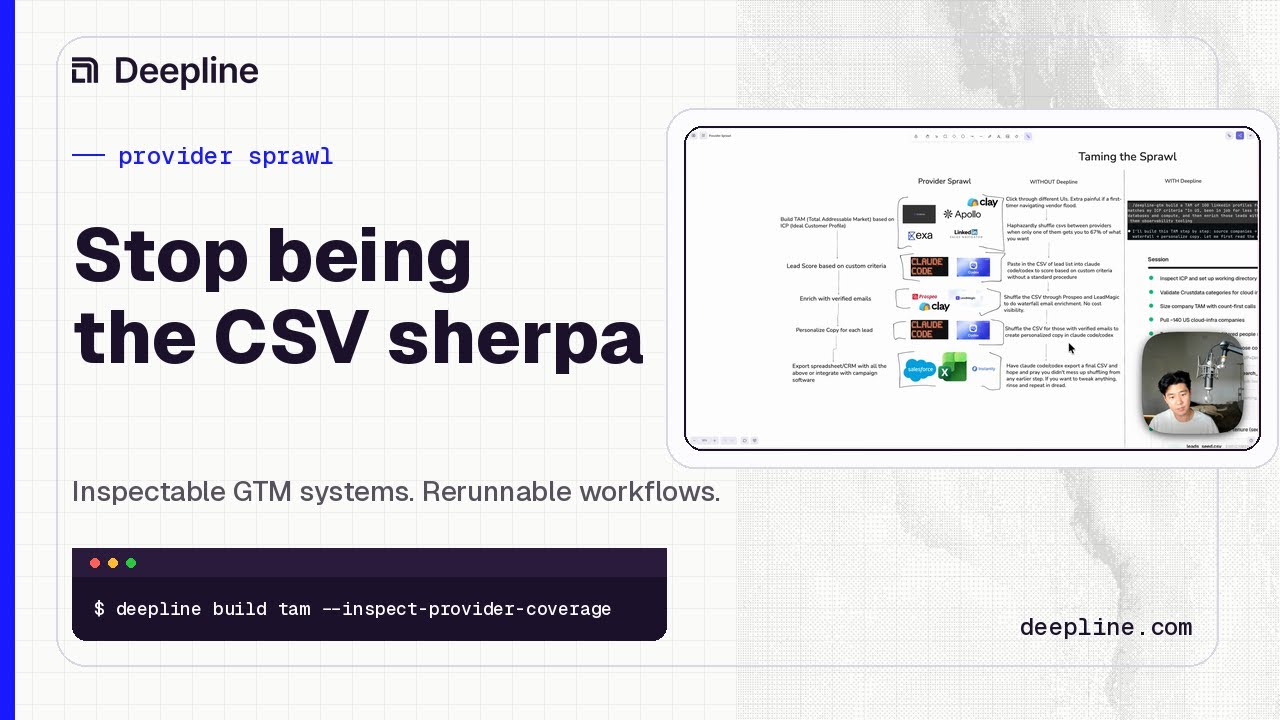
Video not loading in LinkedIn or your in-app browser? Watch it on YouTube.
Provider sprawl happens when a GTM team depends on too many disconnected data vendors, enrichment tools, spreadsheets, and CRM fields to build one outbound list. The real work becomes stitching, reconciling, and cleaning provider output instead of deciding who to target.
Direct answer
Provider sprawl is what happens when a GTM workflow depends on too many disconnected tools. It usually starts with a simple TAM request and ends with CSV exports, enrichment vendors, scoring prompts, CRM imports, and a final list that only one person understands.
Every GTM team says it wants a better TAM list. What it usually means is:
Can someone please combine these eight half-true datasets and not lose the good rows?
That person becomes the CSV Sherpa. They know which vendor has decent company data, which one has passable emails, which one overcounts headcount, which one lies politely, and which one should only be trusted after lunch.
What the video shows
Sung frames TAM building as a workflow problem:
- multiple providers each contribute partial truth
- the useful logic lives between providers, not inside one provider
- the operator needs to inspect decisions instead of blindly trusting a table
- a good workflow should be rerunnable when the ICP changes
This is the right wedge for growth engineers. They do not need another dashboard. They need a way to turn messy provider logic into something reliable.
The core issue
Provider sprawl breaks GTM teams in three places:
- context gets lost between exports
- quality rules live in someone's head
- the workflow cannot be repeated without manual labor
The spreadsheet is not the enemy. The problem is pretending the spreadsheet is the system of record for the workflow.
The better way
The better version of TAM building treats each provider as an input:
- pull useful data from each source
- make provider confidence and coverage visible
- keep list-building rules close to the workflow
- preserve why a company made it into the list
- make the whole thing easy to rerun
That is how a GTM team stops asking, "Who has the latest CSV?"
Video chapters
| Time | Chapter |
|---|---|
| 00:00 | Building a TAM from an ICP |
| 00:36 | Provider sprawl enters the workflow |
| 01:30 | CSV shuffling and low coverage |
| 02:03 | Waterfall enrichment and cost opacity |
| 03:00 | Deepline as the better path |
| 04:43 | Inspecting the enrichment waterfall |
| 05:07 | Final lead CSV |
Search terms this page targets
- build TAM list
- provider sprawl
- GTM provider sprawl
- outbound list building workflow
- Clay alternative for technical GTM teams
- sales data provider workflow
FAQ
What is the real cost of provider sprawl?
The real cost is not only vendor spend. It is the inability to explain how a list was built, which providers worked, why a lead was included, and how to rerun the same process later.
Are CSVs bad for GTM workflows?
No. CSVs are useful outputs and inputs. They become a problem when they act as the workflow engine and hide routing, approvals, scoring, and provider decisions.
What should a TAM workflow produce?
It should produce a campaign-ready list plus the record of how that list was built: account criteria, providers used, enrichment results, scoring logic, and export destination.