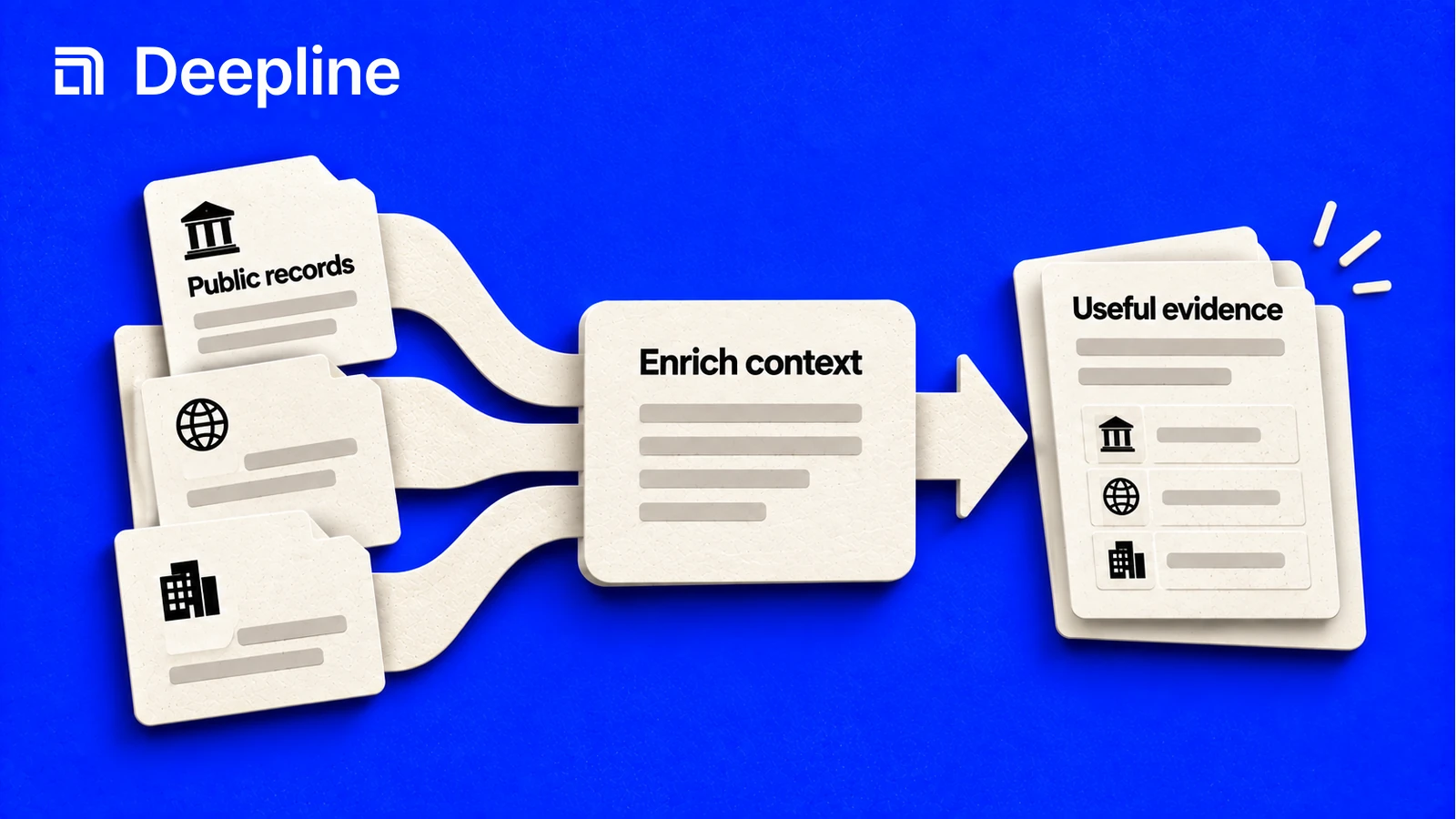
Most outbound starts from the same three databases.
That is why so much AI-written outbound sounds identical. The model changes the wording, but the underlying signal is still the same: funding, job changes, headcount, tech stack, profile blurbs, generic intent.
A permissionless value prop starts earlier.
It asks: what public or semi-public source records the real event, asset, gap, license, filing, inspection, permit, ownership trail, or operational risk in this market?
Then it uses private enrichment only where private data is useful: resolving the buyer, contact route, account match, parent company, territory, or suppression rule.
The result is not "personalized copy." It is a source-backed reason to contact the account.
The Short Definition
A permissionless value prop is a useful insight you can give a prospect before they know, trust, or meet you.
Jordan Crawford popularized this framing through the Cannonball GTM methodology. The practical version for GTM teams is simple:
- Public data reveals the account reason.
- Private enrichment resolves the buyer.
- First-party context decides the action.
- The workflow preserves the evidence.
- The message leads with the finding, not the product.
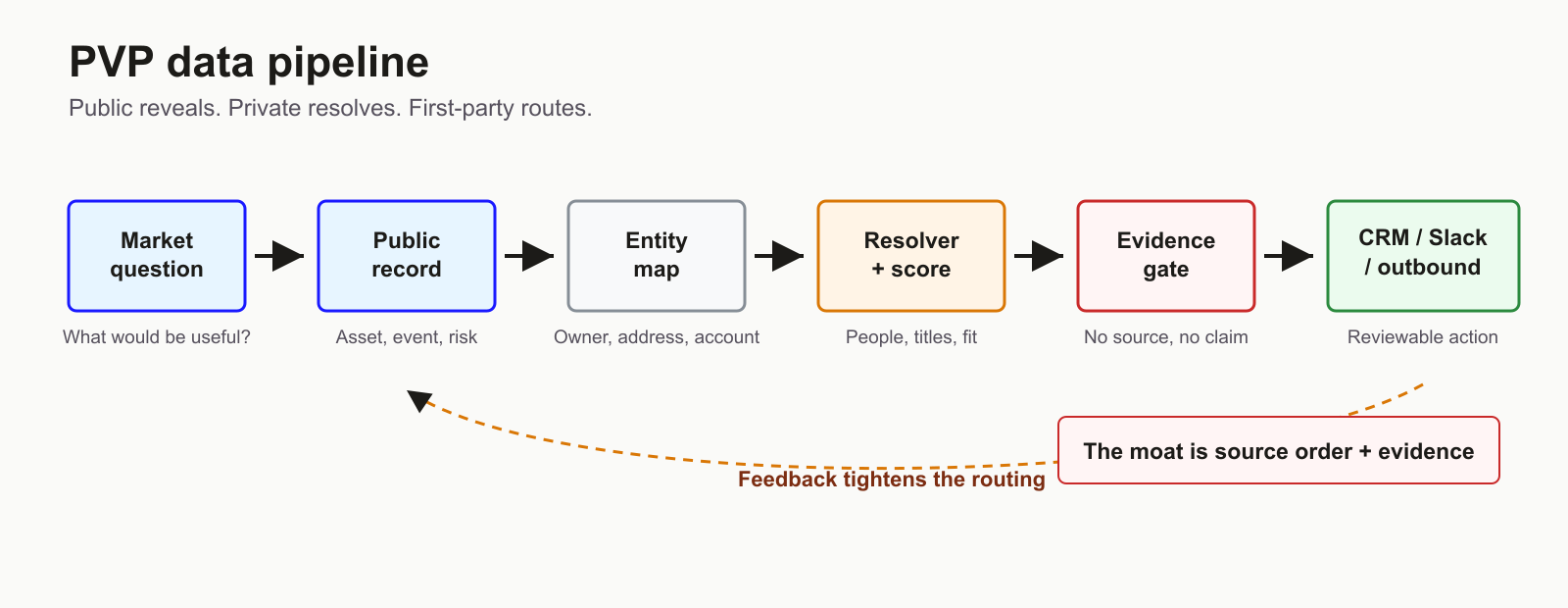
The edge is source order: public record first, resolver second, first-party filter third.
Why The Data Chain Matters
Generic outbound starts with people. PVP outbound starts with evidence.
| Generic AI outbound | Permissionless value prop outbound |
|---|---|
| "I saw you are hiring." | "Your permit, filing, ownership trail, or safety record points to a specific gap." |
| Starts with a contact database. | Starts with the source of truth for the market. |
| Optimizes copy variants. | Builds a better account reason. |
| Personalization is pasted into a first line. | Evidence decides who gets contacted. |
| Depends on more volume. | Depends on better source order and review. |
This is the useful distinction: the copy is downstream. If the record is generic, the message will be generic.
The Source Map
Use this before writing a single outbound line.
| Field | Question |
|---|---|
| Market question | What finding would be useful before we pitch? |
| Public source of truth | Which registry, permit, inspection, license, filing, record, or event log captures the signal? |
| Entity join | How do we connect the record to a company, owner, location, parent, account, or CRM object? |
| Private resolver | Which provider resolves the buyer, title, email, phone, profile, or missing firmographic field? |
| First-party filter | Which CRM, customer, product, territory, or suppression rule changes the action? |
| Evidence fields | Which source URL, record ID, date, field, and reason must survive into the output? |
| Review gate | What gets dropped before activation? |
| Action | Create account plan, route to Slack, add to CRM, send to sequence, or suppress. |
Where /last30days Fits
Use /last30days when the market is still fuzzy.
mvanhorn/last30days-skill is an agent-led research skill for finding what people have said, shared, watched, debated, bet on, and shipped in the last 30 days. It searches sources like Reddit, X, YouTube transcripts, TikTok, Instagram, Hacker News, Polymarket, GitHub, arXiv, Techmeme, and the web, then synthesizes the results into a cited brief.
Our Deepline research workflow is forked from mvanhorn/last30days-skill. We use the upstream engine as the public-conversation scout, then adapt the output for Deepline's PVP job: source discovery, dataset selection, join-key design, enrichment planning, and proof-safe outbound.
| Upstream link | Use it for |
|---|---|
mvanhorn/last30days-skill repo | README, install commands, source list, examples, and project context. |
| Runtime skill spec in the upstream repository | Command behavior, setup flow, source handling, --agent mode, and output rules. |
| Scripts directory | The research engine implementation and source connectors. |
| Issues | Source gaps, bugs, roadmap discussion, and integration edge cases. |
| Pull requests | Recent source additions, fixes, and community-contributed changes. |
The important part is the ranking logic. Google mostly ranks pages. /last30days is trying to rank people-backed signal: Reddit upvotes, X likes, YouTube views and transcripts, TikTok and Instagram engagement, Hacker News points, GitHub activity, and Polymarket odds backed by money.
For PVP work, that makes it useful before we know the right source of truth. It shows what operators are arguing about, which datasets they keep naming, which scrapers or APIs already exist, and what language real buyers use.
It is not the production data pipeline. It is the scout. Deepline research turns the trail into the operating plan.
| Stage | Tool | Output |
|---|---|---|
| Discovery | /last30days in Claude Code | Recent public breadcrumbs, source candidates, market language, papers, repos, scrapers, and dataset hints. |
| Source plan | Deepline research | Exact artifacts, canonical URLs, mirrors, parsers, join keys, Deepline route classification, and cost/probe gates. |
| Execution | Deepline workflow | Pull rows, normalize entities, enrich buyers, apply first-party filters, preserve evidence, review, activate. |
The distinction matters: /last30days tells us where the public data probably lives and what operators call it. Pre-research decides whether the source is materializable.
Claude Code Input Examples
These are the kinds of prompts we use when scouting a PVP source:
/last30days "MSHA mining safety predictive model accident violations data" --agent

/last30days "restaurant owner phone number data sources public records SOS liquor license health permit business license API 2025 2026" --agent

/last30days "public and private datasets for sourcing Registered Investment Advisors RIA prospecting SEC IAPD Form ADV wealth management firm data advisor contact enrichment" --agent

/last30days "public datasets nursing home compliance survey deficiencies falls pressure ulcers infection readmission claims staffing quality measures skilled nursing" --agent
Write the prompt like a data operator, not a content marketer. Bad prompt: "Find creative outbound ideas for restaurants." Better prompt: "Find public records and APIs that expose restaurant owner names, license events, opening dates, health permits, liquor applications, or business entity links."
What The Results Look Like
/last30days returns the messy public trail. Deepline research decides what we can actually build.
| Market | Useful /last30days output | Deepline research handoff |
|---|---|---|
| Mining safety | Reddit safety threads, X posts about MSHA enforcement, mining-fatality records, inspection-rule discussion, and pointers toward accident, violation, inspection, employment, and penalty data. | Resolve exact MSHA open-data artifacts; keep Mine ID, operator, controller, address, commodity, accident, inspection, violation, assessed penalty, employment, and production fields; design the 25-mine review sample. |
| Restaurant owners | Liquor-license application language, public-list timing, Google Maps/contact extraction routes, Apify actors, GitHub public-record tools, and examples of city/state license databases. | Choose the city/state spine; join license, legal entity, DBA, address, website, ordering page, Google Business Profile, owner/operator clues, chain suppression, and contact verification. |
| Registered investment advisors | SEC/IAPD and Form ADV references, scraper candidates, adviser profile fields, registration status, disclosure flags, addresses, and contact-enrichment patterns. | Use SEC/IAPD as the spine; keep CRD/SEC number, firm name, address, registration status, Form ADV date, disclosure flags, AUM/team clues where available, and enrich reachable advisor/operations contacts. |
| Skilled nursing facilities | CMS SNF Quality Reporting Program, inspection-report guides, Five-Star technical docs, staffing/quality-measure language, and operator/admin pain language from public posts. | Use CMS provider IDs and public facility records; keep deficiency tags, survey dates, staffing measures, quality measures, ownership/facility page, administrator/DON contact routes, and claim-safety rules. |
Anchor Example: Mining Safety Companies
The mining safety example is the clearest version because the initial ask was not obvious:
How do we find mining companies or mines that may need mining safety gear?
The better operator question was:
Can we predict which mines may have higher safety-equipment urgency, then find the right safety or operations buyer?
That changed the workflow from "find mining companies" to "build a source-backed safety account list."
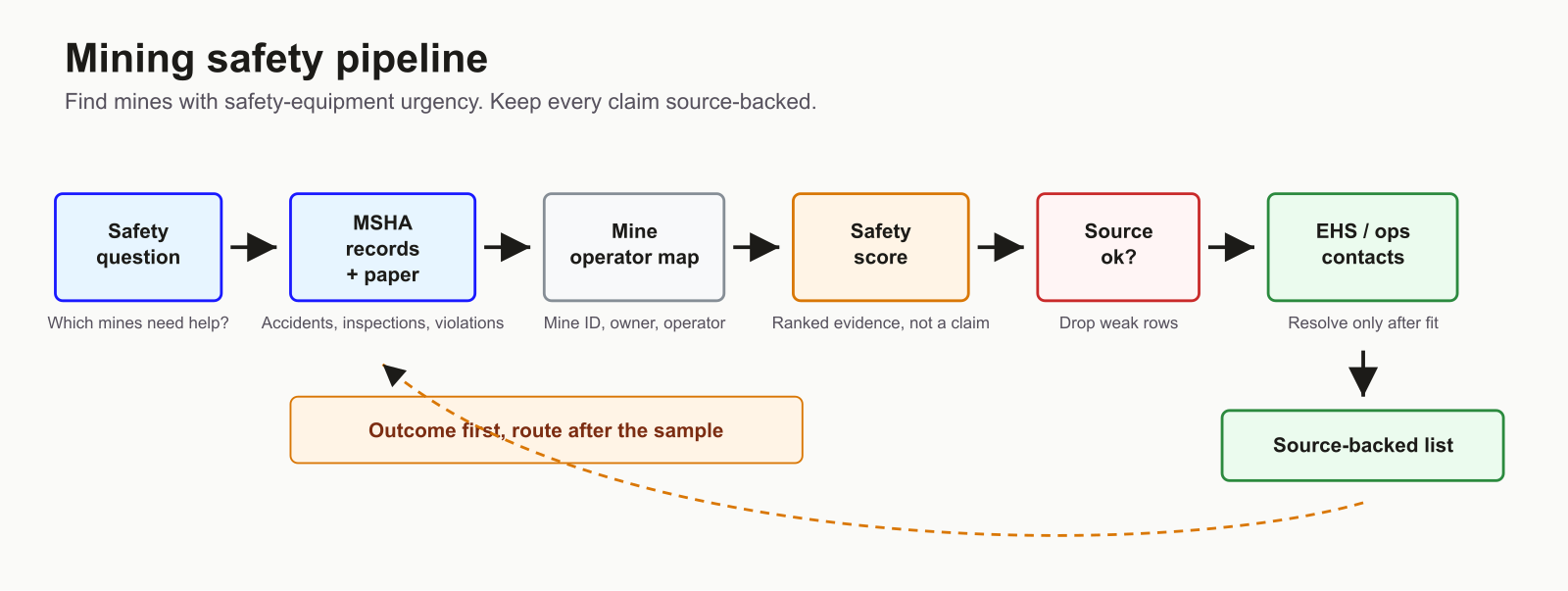
The public spine is MSHA data. Private enrichment happens after the account reason exists.
| Step | Source or action | Why it matters |
|---|---|---|
| Public spine | MSHA accident, inspection, violation, employment, production, address, and penalty data | Creates a safety-relevant record system. |
| Research breadcrumb | Public web research and academic work on mining safety prediction | Helps choose the scoring route before enrichment starts. |
| Entity map | Mine ID, operator, controller, address, commodity, status | Prevents the workflow from scoring the wrong company. |
| Score | Safety-relevant evidence, not a claim of certainty | Ranks accounts for review without overstating the finding. |
| Resolver | EHS, operations, site, safety, and executive contacts | Finds people only after the account reason exists. |
| Output | Source-backed account list | Gives the seller a useful reason to reach out. |
MSHA's open data portal lists accident injuries, inspections, mine addresses, mines, violations, assessed violations, employment, production, and related data sets. Data.gov also indexes MSHA data sets for violations, inspections, mine addresses, the Mine Data Retrieval System, and accident injuries.
The message shape is:
We mapped MSHA accident, inspection, violation, employment, and penalty records to identify mines with patterns that may indicate higher safety-equipment urgency. We also mapped likely safety and operations contacts. Want the source-backed list?
The important part is not the line. It is the evidence trail behind the line.
Office-Hours Example: FAA To Wealth Management
We used the same pattern in office hours for wealth management prospecting.
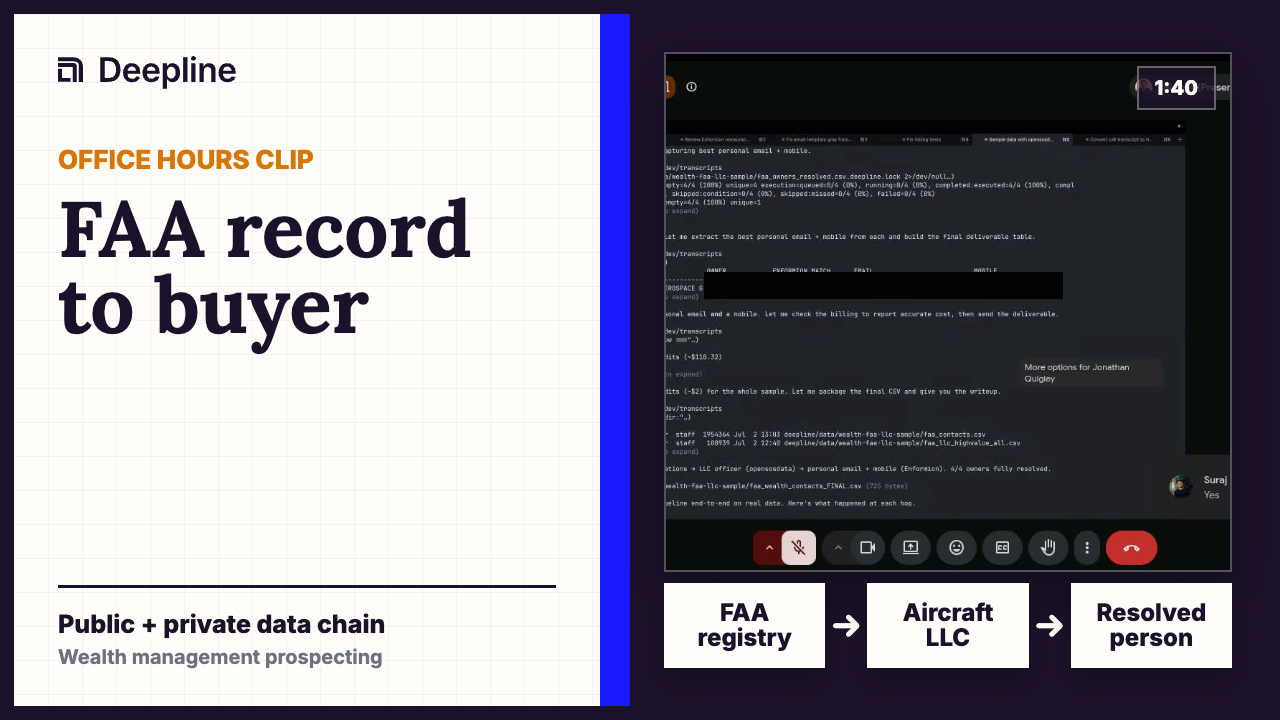
Watch the July 2 office-hours clip: FAA registrations, LLC trails, Secretary of State records, and private enrichment chained into a prospecting workflow.
The chain:
- FAA aircraft records identify the asset.
- LLC and Secretary of State records expose the ownership trail.
- Address and entity matching connect the record to a real person or company.
- Private enrichment resolves likely operators, executives, or owners.
- Social and CRM context decide whether the account deserves action.
None of the sources is impressive alone. The value comes from the join.
Internal Patterns We Keep Seeing
The same public-private pattern keeps showing up across Deepline workflows, office hours, and customer-style research sessions.
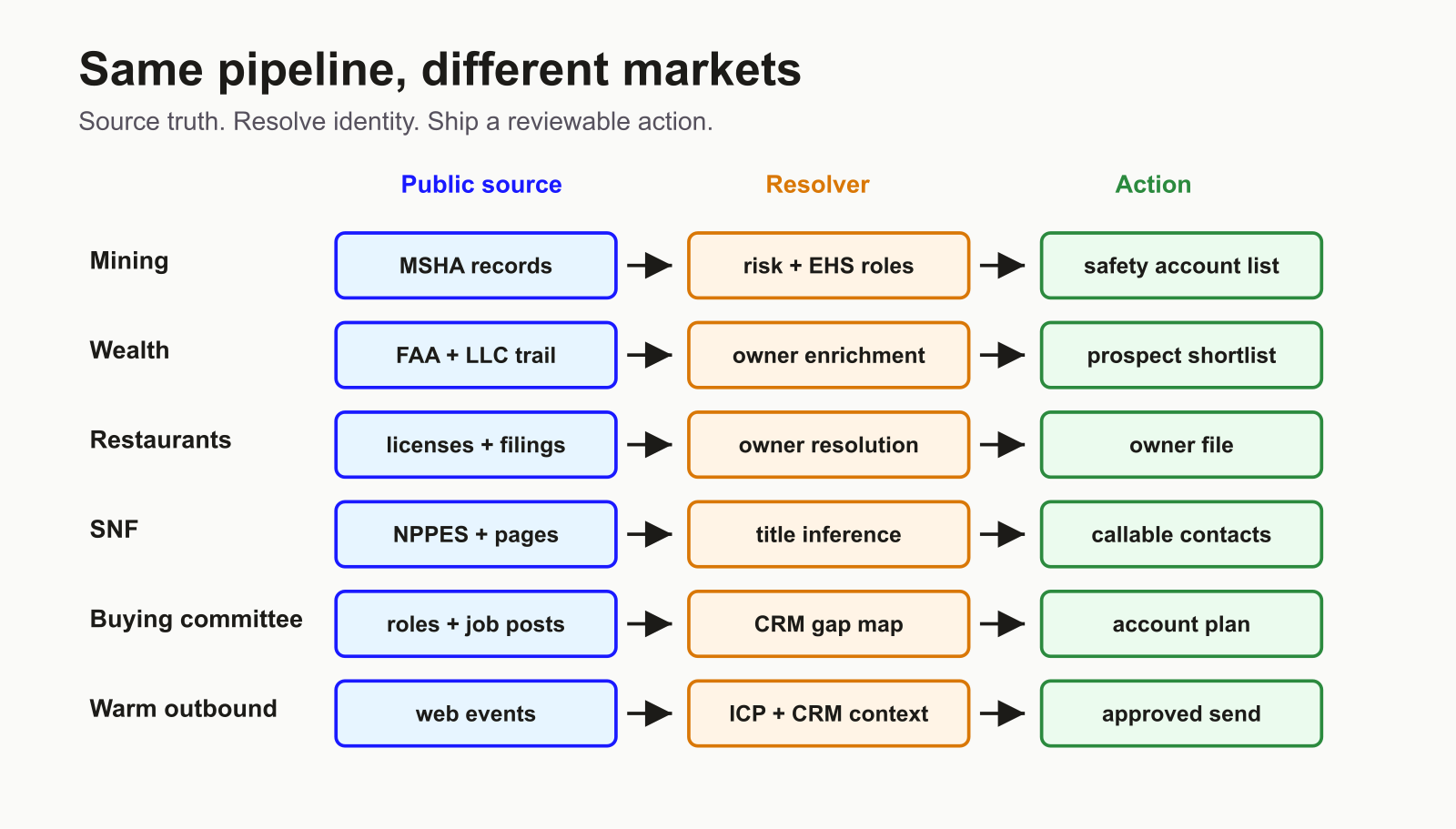
Different markets, same shape: source of truth, resolver, first-party filter, evidence gate.
| Market | Public source | Private or first-party layer | Useful output |
|---|---|---|---|
| Wealth management | FAA aircraft registry, LLC records, Secretary of State filings, address trails | Contact enrichment, social validation, CRM fit | Likely aircraft-owning prospects with source trails. |
| Restaurant owners | Chicago Open Data licenses, California business filings, websites, review pages, ordering pages, local news | Owner/contact enrichment and known-good examples | Likely owner, evidence trail, conflicts, confidence. |
| Skilled nursing facilities | NPPES, facility pages, search-result snippets | Customer contacts, email-prefix inference, validation fields | Contacts recovered by operational role. |
| Buying committees | Public profiles, team pages, job posts, TheOrg-style data, job boards | CRM target accounts and enrichment | Gap map of missing roles in the account plan. |
| Warm outbound | Website events and account activity | CRM, ICP scoring, enrichment, Slack approval | Approved send or suppress decision. |
| CRM repair | Deals, contacts, companies, domains, public company evidence | HubSpot or Salesforce context and fallback enrichment | Recovered account association and next action. |
Two public office-hours recordings show the method:
| Session | Clip | What it shows |
|---|---|---|
| July 2 | Wealth management prospecting from public and private data | FAA records, LLC trails, Secretary of State records, address matching, and private enrichment chained into a prospecting workflow. |
| June 25 | Data provider testing and public-then-proprietary strategy | Test public sources first, then use proprietary enrichment where it resolves identity or action. |
Use these as proof of operating method, not proof of booked meetings.
Parallels In Other Industries
This is not mining-only or wealth-management-only.
| Industry | Public or external source | Private or first-party layer | Useful output |
|---|---|---|---|
| Construction and equipment rental | DOT equipment transit permits, building permits, contractor licensing data | Account ownership and contact enrichment | Equipment or project gap analysis. |
| Roofing and building products | Building-permit data and contractor activity | Contractor decision-maker resolution and product context | Contractor upsell or displacement list. |
| Health care | NPPES/NPI records, facility pages, public provider evidence | Customer list, CRM context, search, scraping | Role recovery and account segmentation. |
| Restaurants | City license records, business owner datasets, state filings, review/order pages | Owner/contact enrichment, known-good examples | Independent owner discovery. |
| Real estate and insurance | Property records, parcel data, permits, hazard data | User-submitted facts, underwriting or CRM data | Property-level risk or valuation context. |
Jordan Crawford's Cannonball GTM guide describes the construction and equipment-rental shape: combine several data sources, then lead with an opportunity the prospect can use. Maja Voje's GTM Strategist writeup shows the same idea applied to a GAF-style campaign using public permit data and contractor activity.
The PVP Builder Checklist
| Question | Good answer | Weak answer |
|---|---|---|
| What public source is closest to truth? | A registry, permit, inspection, license, filing, NPI, aircraft record, or event log. | "LinkedIn says they are growing." |
| What does the source reveal? | Asset, event, gap, risk, ownership, compliance, or timing. | A generic firmographic segment. |
| What private resolver is needed? | Person, title, email, phone, profile, account, parent, territory. | More enrichment for its own sake. |
| What first-party context changes the action? | Closed-won pattern, ICP rule, CRM owner, suppression, product fit, channel rule. | None. Every matched row gets emailed. |
| What evidence should survive? | Source URL, record ID, date, field, confidence, reason. | A first line with no trail. |
| What would the prospect forward? | A market finding, risk list, gap map, or named account insight. | A product pitch with a token variable. |
Guardrails
This style of outbound only works if it stays true.
- Do not claim a predicted accident, legal risk, financial loss, or compliance issue unless the source and model support that exact claim.
- Do not turn a demo workflow into a fake customer result.
- Do not use private enrichment as proof unless the result was verified.
- Do not expose customer names, provider spend, or internal lists.
- Do not send rows that fail the evidence gate.
FAQ
What is a permissionless value prop?
A permissionless value prop is an account-specific insight a prospect can use before they know, trust, or meet you. It usually comes from joining public records, private enrichment, and first-party context into a source-backed reason to reach out.
How many data sources should a PVP use?
Use enough sources to create a useful insight, not more. Crawford's Cannonball GTM guide uses 2 to 5 unique data sources as the operating range. In practice, start with one public source of truth, one resolver, and one first-party filter.
Why start with public data?
Public data often records market reality: permits, filings, inspections, licenses, aircraft, providers, property records, and events. Private enrichment is better after the public record tells you which account deserves attention.
Why is private enrichment still needed?
Public data often shows the signal but not the buyer. You still need to resolve ownership, titles, emails, phones, CRM matches, parent companies, territories, and exclusions.
How is this different from AI SDR personalization?
AI SDR personalization usually writes faster from common signals. PVP work happens upstream. It chooses better records, joins them in the right order, preserves evidence, and writes only after the reason to contact is clear.
What is the best first test?
Pick one niche where public records are dense and buyer pain is concrete. Build a 25 to 50 account sample. Review evidence manually. Only then decide whether the workflow deserves more volume.
Sources
- Jordan Crawford and Cannonball GTM: A Quick and Dirty Guide to the Cannonball GTM Methodology
- Jordan Crawford on The Transaction: Inverting your Go-To-Market Strategy Thinking
- The RevOps Review: How to Build Data-Led Outbound with Jordan Crawford
- Maja Voje, GTM Strategist: How to Build GTM Campaigns Your Prospects Would Pay to Receive
- MSHA: Open Government Initiative Portal
- Data.gov: MSHA dataset search
- FAA: Aircraft Inquiry
- NPPES: NPI Registry API
- City of Chicago: Business Licenses
- City of Chicago: Business Owners
- California Secretary of State: Business Entities
- last30days:
mvanhorn/last30days-skill, scripts - Google Search Central: AI optimization guide