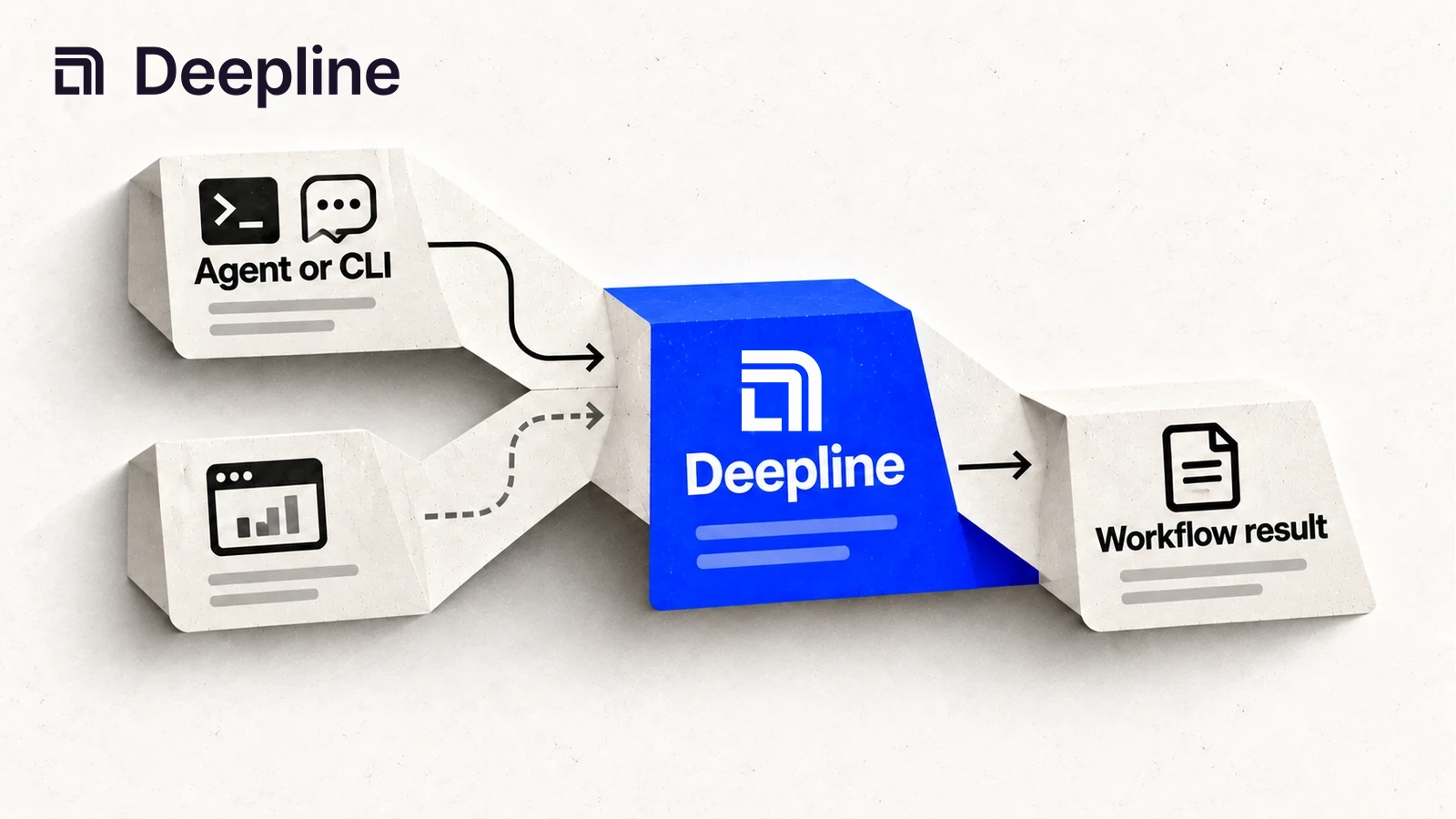
Where Apollo fits in a headless GTM workflow
Apollo can supply prospecting and enrichment capabilities within a headless GTM workflow. Keep candidate search, contact enrichment and downstream actions separate. Apollo documents People Search and People Enrichment as separate API operations, checked September 14, 2026.
An operator can ask a coding agent to inspect the Apollo integration for Claude Code, identify the needed action, and prepare an authorized pilot. Review identity, returned fields and access requirements before treating a search result as a verified contact. Then validate the required channel and review the destination write or campaign handoff.
“Headless” describes how the workflow is operated; it does not eliminate provider access requirements or the need to review evidence. Use the profile-to-contact guide for identity and verification, and the Deepline–Apollo comparison when deciding which parts of the workflow each product should own.
The short answer
A headless GTM platform is a go-to-market system where workflow logic and execution are exposed through APIs, SDKs, CLIs, or MCP tools instead of being trapped inside a dashboard. Databar defines headless GTM around terminal or agent-driven GTM through MCP, SDK, and API tools. Databar Headless GTM article
Claude Code, Codex, Cowork, scripts, Slack workflows, CRM buttons, and internal apps should be able to call the same GTM actions. Anthropic documents MCP as a way for Claude Code to connect to external tools and data sources; OpenAI describes Codex app workflows around worktrees, skills, automations, and review. Anthropic Claude Code MCP docs, OpenAI Codex app
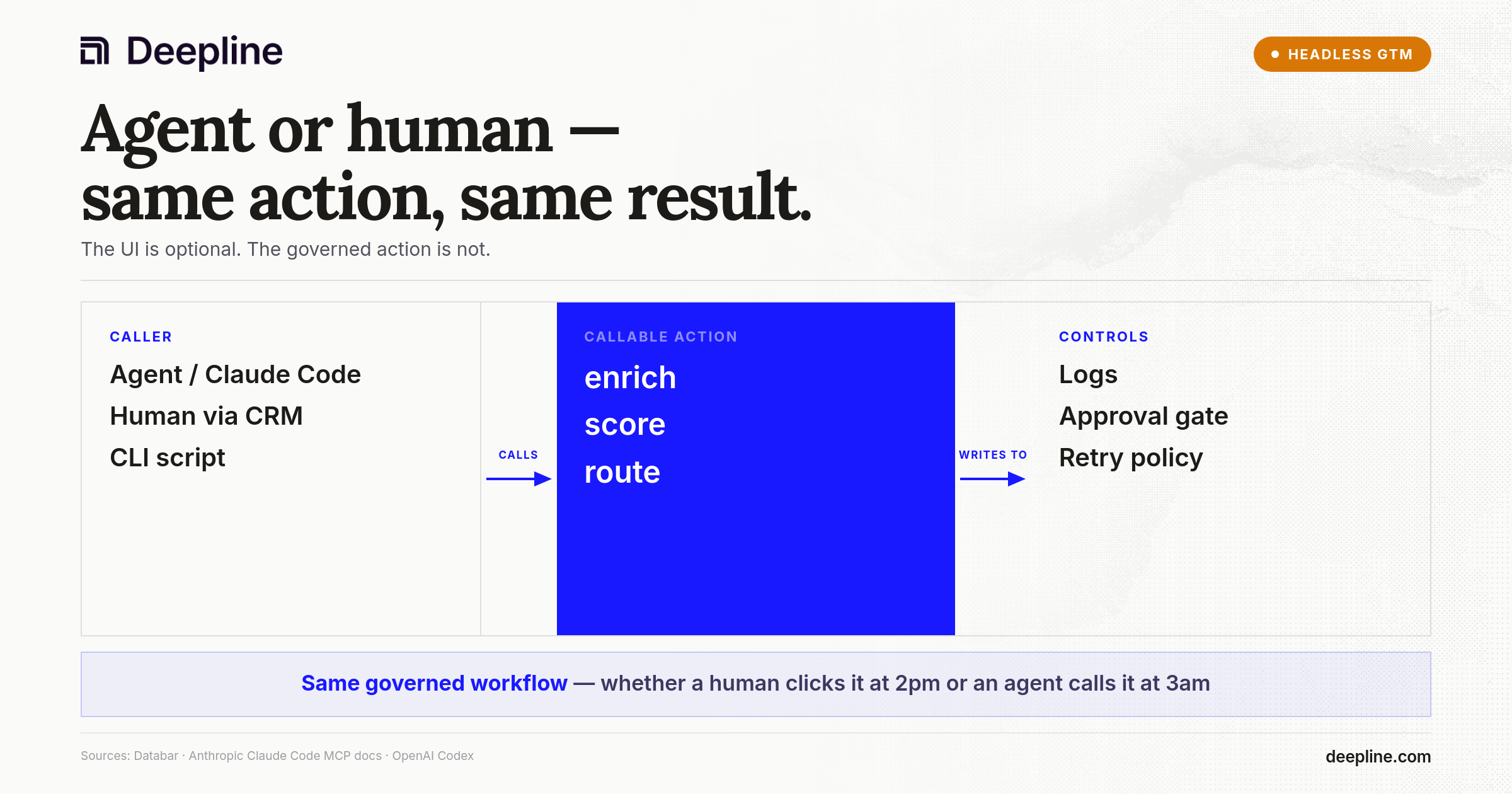
Diagram sources:
Databar Headless GTM article
,
Anthropic Claude Code MCP docs
, and
OpenAI Codex app
.
What the data says
"Headless GTM" is early language. Treat that as a strength, not a weakness.
| Data point | Source | Read it this way |
|---|---|---|
| A Reddit thread used the exact phrase "Headless GTM Platform." | Headless GTM Platform Reddit thread | The phrase is still early community language. This is a category-definition opportunity. |
| Databar published a dedicated "Headless GTM" article in April 2026 and defines it around terminal or agent-driven GTM through MCP, SDK, or API tools. | Databar Headless GTM article | The phrase is becoming market language. The clearer infrastructure read is: GTM workflows should be callable, inspectable, and governed. |
| Anthropic documents Claude Code MCP, slash-command prompts, resources, hooks, routines, and multi-agent workflows. | Anthropic Claude Code overview, Anthropic Claude Code MCP docs | Claude Code is already built for callable toolchains. GTM actions need to meet it there. |
| OpenAI's Codex app supports worktrees, skills, automations, sandboxed agent work, and review queues. OpenAI Academy also lists sales workflows like pipeline prioritization and forecast review. | OpenAI Codex app, OpenAI Academy sales use cases | Codex is becoming a GTM-adjacent work surface when the data is structured and the actions are reviewable. |
| Clay, Cargo, and ZoomInfo each describe GTM surfaces: workflow canvas, AI workforce, and GTM intelligence. | Clay homepage, Cargo docs, ZoomInfo 2024 Form 10-K | The point is not "no UI." The point is API-first, UI-optional, and agent-callable. |
The simple definition
Headless GTM means the GTM workflow is separated from the UI.
In a dashboard-first GTM tool, the user clicks through tables, buttons, filters, and tabs. In a headless GTM platform, the user or agent calls actions:
- Find target accounts.
- Enrich companies and contacts.
- Resolve identities.
- Score accounts.
- Generate account research.
- Route records.
- Push reviewed leads to CRM or sequencer.
- Log what happened.
- Retry failures.
- Ask for approval before risky actions.
The interface can be Claude Code, Codex, Cowork, a CLI, an SDK, a web app, a CRM button, or a visual dashboard.
Why this is emerging now
Three shifts made Headless GTM practical:
- Coding agents became usable for multi-step work.
- GTM tools started exposing more APIs, MCP servers, and SDKs.
- GTM teams began hiring operators who can combine RevOps judgment with technical implementation.
Databar has named the headless GTM category. OpenAI and Anthropic document agents operating across files, tools, repos, and business workflows. Job postings from companies like Glean, Light Labs, Foley, Gong, Hebbia, Lucid, Recorded Future, Apollo, and Zyphra show GTM systems work appearing in role descriptions. Databar Headless GTM article, OpenAI Codex app, Anthropic Claude Code overview, Glean posting, Light Labs posting, Gong posting, Hebbia posting, Lucid posting, Recorded Future mirrored posting, Apollo mirrored posting, Zyphra mirrored posting
Headless does not mean no UI
The best framing is not "terminal or dashboard." It is "API first, UI optional."
A visual table is useful when:
- A human needs to inspect rows.
- A client needs to review output.
- A sales team needs to understand what happened.
- A manager needs a dashboard or report.
An API-first workflow is useful when:
- An agent needs to run the same workflow repeatedly.
- The workflow must be tested.
- The same action should run from many places.
- The team needs logs, retries, and versioning.
- The workflow should be embedded into product, CRM, Slack, or internal tools.
Headless GTM works when both are true: agents can call the system, and humans can inspect the result.
That second half matters. A headless workflow with no inspection layer is just invisible automation. GTM teams already have enough invisible automation.
What a headless GTM platform needs
| Layer | Requirement | Why it matters |
|---|---|---|
| Data model | Companies, people, events, accounts, runs, outputs | Agents need structured objects, not pasted screenshots. |
| Actions | Enrich, search, score, route, write, notify | GTM work must be callable. |
| Provider routing | Choose provider, waterfall, retry, or stop | Agents should not hardcode fragile vendor logic. |
| Permissions | Read/write scopes, approval gates, tenant boundaries | GTM actions can affect customers, prospects, and compliance. |
| Observability | Run logs, errors, costs, output diffs | Teams need to know what happened and why. |
| Test endpoints | Dry runs, small-row tests, validation checks | Agents need a way to verify behavior before scaling. |
| Human review | Approve, edit, reject, rerun | Consequential GTM actions need judgment. |
| Interfaces | API, SDK, CLI, MCP, web UI | Different users and agents need different surfaces. |
What this looks like in practice
| Workflow | Dashboard-first version | Headless version |
|---|---|---|
| Account enrichment | A user imports a CSV, adds columns, waits, checks rows, and exports. | An agent calls an enrichment action, runs a 10-row test, inspects misses, then scales with logs. |
| Signal-based outbound | A marketer manually copies trigger accounts into a table. | A signal creates a run, resolves the company, enriches contacts, drafts messaging, and asks for approval. |
| Forecast risk | A manager reads CRM notes, call transcripts, Slack, and spreadsheets by hand. | Codex or Cowork assembles a risk memo from approved sources and separates facts from inferred risk. |
| CRM writeback | A workflow updates fields when a table run finishes. | The system writes through a governed action with validation, permissions, and retry behavior. |
| Human review | Review happens inside one tool's table. | Review can happen in Deepline, Slack, CRM, or a document, because the underlying action is the same. |
How Deepline defines the category
Deepline defines Headless GTM as:
Headless GTM is GTM infrastructure that agents can operate. The workflow is exposed through APIs, SDKs, CLIs, and MCP tools, while humans still get dashboards, logs, and approval points where they need them.
That keeps the position pragmatic. The point is not to remove the UI. The point is to stop making the UI the only place work can happen.
Examples of headless GTM workflows
Signal-to-outbound workflow
An agent detects a relevant market signal, resolves the company, enriches decision-makers, validates emails, scores fit, drafts outreach, asks for approval, then pushes approved records to a sequencer.
Product-qualified lead workflow
A product event crosses a usage threshold. The system enriches the account, checks CRM ownership, creates a summary, routes to the account owner, and logs the action.
Competitive-account workflow
An agent researches companies using a competitor, validates evidence, enriches relevant roles, writes a reason-to-reach-out field, and asks a human to approve the final account list.
Event follow-up workflow
The system ingests an attendee list, deduplicates against CRM, enriches missing records, scores fit, segments the audience, and creates follow-up plays by persona.
Sources
- Databar Headless GTM article
- Anthropic Claude Code overview
- Anthropic Claude Code MCP docs
- Anthropic Claude Cowork
- OpenAI introducing the Codex app
- OpenAI Academy: how sales teams use Codex
- OpenAI Codex overview
- Growth Unhinged Claude for GTM report
- Reddit: Headless GTM Platform thread
- Glean GTM Engineer posting
- Foley Applied AI Engineer, Small Market Growth and Revenue Systems posting
- Clay homepage
- Cargo docs