The short answer
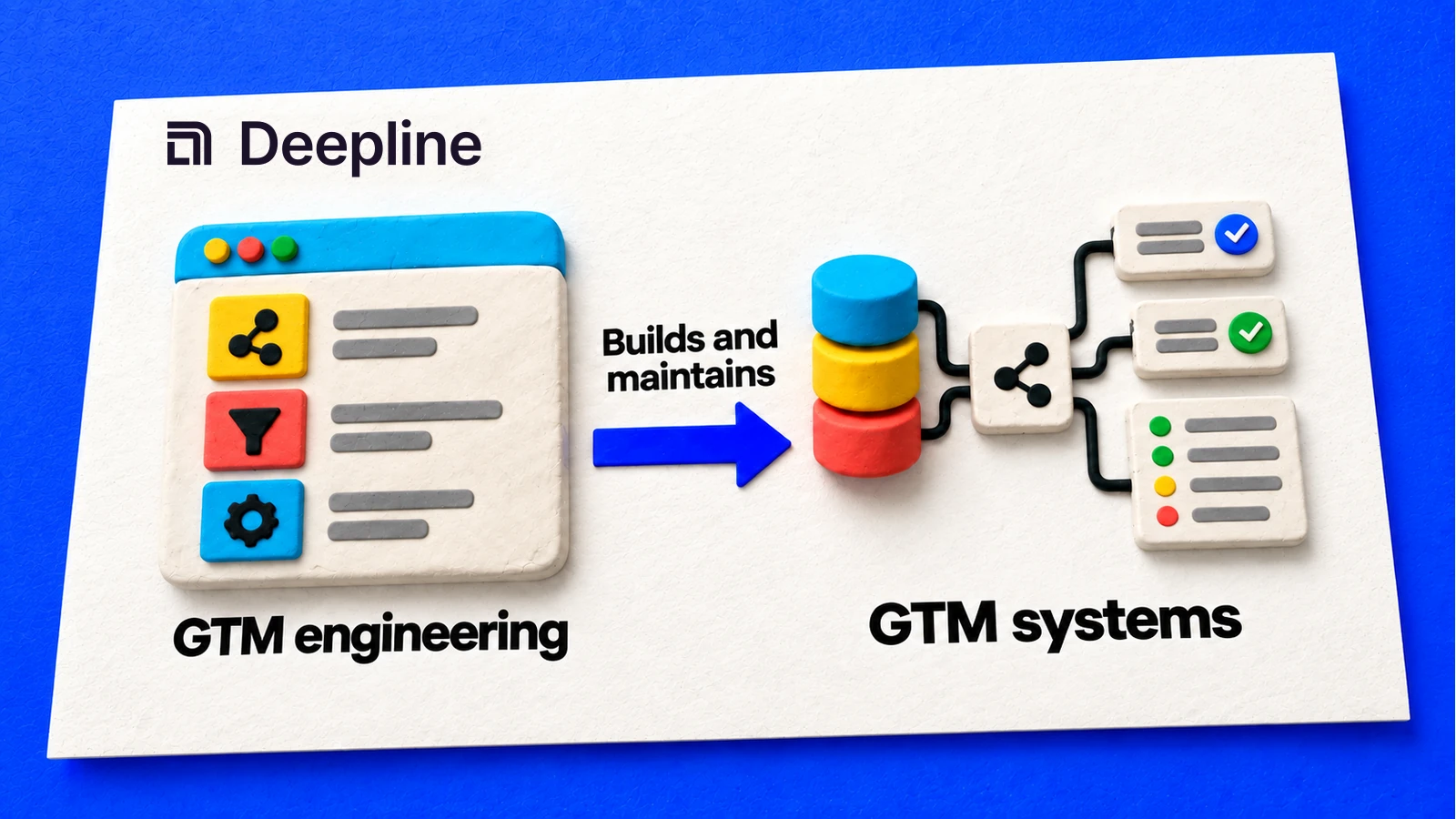
GTM Systems are the repeatable workflows, data models, automations, tools, and operating rules that turn go-to-market strategy into execution. GTM Engineering is the discipline and role that designs, builds, and maintains those systems. Apollo defines the GTM Engineer as the technical operator who designs, builds, and maintains GTM systems; Cremanski frames GTM Engineering as a technical discipline inside RevOps. Apollo GTM Engineer explainer, Cremanski GTM Engineering explainer
A Headless GTM Platform is a GTM infrastructure layer that agents and scripts can operate through APIs, SDKs, CLIs, or MCP rather than through a dashboard-first UI. Databar Headless GTM article, Anthropic Claude Code MCP docs
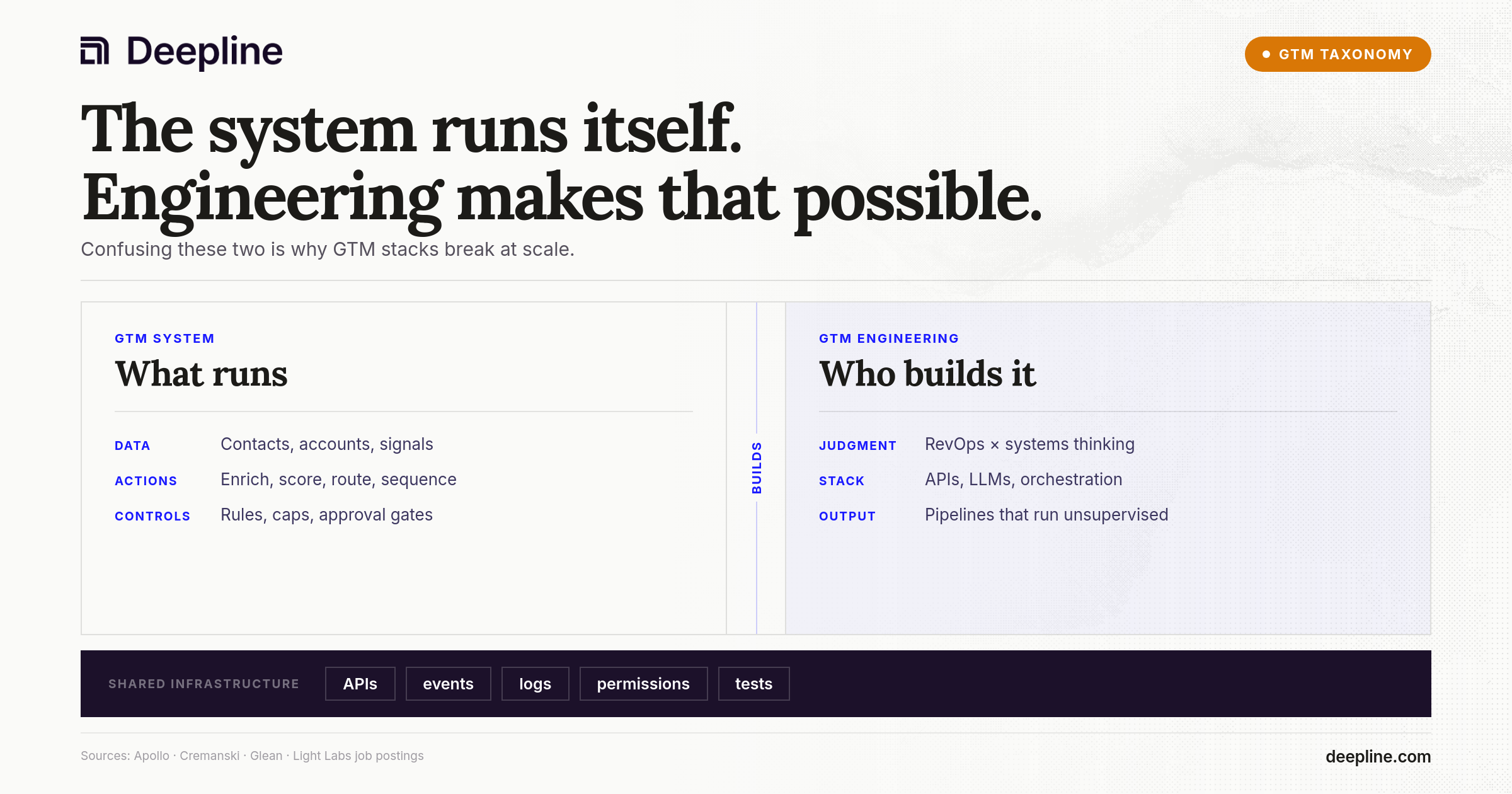
Diagram sources:
Apollo GTM Engineer explainer
,
Cremanski GTM Engineering explainer
,
Glean GTM Engineer posting
, and
Light Labs GTM Engineer posting
.
What the research says
The useful signal is not one perfect definition. It is the same pattern showing up in community posts, creator content, and job descriptions.
| Data point | Source | Why it matters |
|---|---|---|
| Reddit threads show practitioners discussing GTM systems, GTM Engineering transitions, and GTM as an engineering problem. | Senior engineer building GTM systems, GTM used to be a sales problem | The search demand is still messy, but the practitioner language is real. |
| RevPartners published a May 2026 talk on creating a GTM operating system. | RevPartners GTM operating system talk | "Operating system" is showing up in RevOps education, not only vendor pages. |
| Glean's GTM Engineer posting asks the hire to build AI-first automation across prospecting, deal execution, onboarding, adoption, renewals, enrichment, scoring, routing, and outreach. | Glean GTM Engineer posting | The role is full-funnel. It is not a narrow outbound automation job. |
| Clarify.ai's GTM Engineer (Growth) posting says the role is not traditional demand generation and not software engineering; it is a systems role across lifecycle automation, outbound, experimentation, SQL, Clay, Customer.io, and tracking. | Clarify.ai GTM Engineer posting | GTM Engineering is becoming a hybrid operator role, not a pure engineering title. |
| Light Labs' GTM Engineer, Agents posting asks for an account-intelligence layer, 3-5 automated GTM workflows, acquisition experiments, and data quality standards in the first three months. | Light Labs GTM Engineer posting | The new role is judged by built systems, not slide decks. |
| Beautiful.ai frames its GTM Engineer role around connecting strategy, automation, execution, and pipeline. | Beautiful.ai GTM Engineer posting | The business buyer does not care what the title is. They care whether the system creates pipeline. |
The clean taxonomy
| Term | Plain-English definition | Example |
|---|---|---|
| GTM System | A repeatable revenue workflow | When a target account hires a VP Sales, enrich the account, find the right contacts, score fit, route to the owner, and prepare outreach. |
| GTM Engineering | The discipline that builds GTM systems | A GTM engineer wires CRM, enrichment, data warehouse, AI research, and sequencing tools into a workflow. |
| GTM Infrastructure | The technical foundation | APIs, events, schemas, run logs, provider routing, permissions, and validation. |
| Headless GTM Platform | Agent-first GTM infrastructure | Claude Code, Codex, Cowork, or another agent can call GTM actions directly instead of clicking through a UI. |
| GTM Revenue Systems | The executive/business-language version | The system of record, operating rhythm, and automations that create pipeline, expansion, retention, and revenue visibility. |
Why this matters for SEO
These keywords are related, but they should not all land on the same page.
"GTM Engineering" attracts people asking about the role. They want definitions, skills, job examples, Clay workflows, RevOps overlap, and how to hire.
"GTM Systems" attracts people who already feel the operational pain. They want a way to make outbound, enrichment, routing, scoring, and revenue workflows repeatable.
"GTM Infrastructure" attracts technical operators. They are asking how to connect data, APIs, agents, CRMs, warehouses, and workflow engines.
"Headless GTM Platform" attracts early adopters who want GTM work to run from Claude Code, Codex, Cowork, Cursor, scripts, or agent workflows.
The hub term is "GTM Systems"; the other terms work best as spokes.
The practical cluster should look like this:
| Keyword | Searcher intent | Best answer |
|---|---|---|
| GTM Systems | "How do we make GTM repeatable?" | Define the operating layer: data, actions, rules, approvals, and observability. |
| GTM Engineering | "What is this role and how do I hire or become one?" | Explain the discipline, skills, and role boundaries. |
| GTM Revenue Systems | "How do we connect pipeline, expansion, retention, and reporting?" | Use executive language and show full revenue lifecycle workflows. |
| GTM Infrastructure | "What technical layer should this run on?" | Talk APIs, schemas, events, provider routing, permissions, logs, tests, and agent surfaces. |
| Headless GTM Platform | "Can agents run GTM workflows without clicking dashboards?" | Explain callable GTM actions, not "no UI." |
What GTM engineering is actually becoming
Apollo defines a GTM Engineer as a technical operator who designs, builds, and maintains systems that power a company's go-to-market motion. Cremanski frames GTM Engineering as a technical discipline inside RevOps, focused on automation, AI, and efficiency rather than replacing RevOps. Apollo GTM Engineer explainer, Cremanski GTM Engineering explainer
That is the right middle ground. GTM Engineering is not "RevOps with a new title", but it is also not a separate kingdom. It is the builder layer inside modern revenue operations.
The best GTM engineers combine:
- RevOps judgment: what should happen in the business process.
- Data engineering: how records, signals, and events move.
- API fluency: how systems talk to each other.
- AI orchestration: when an agent should research, reason, write, or act.
- Governance: what should be logged, approved, retried, or blocked.
- Experimentation: how every campaign and workflow teaches the next one.
If that sounds broad, it is because the role sits where old GTM stacks are breaking. The spreadsheet, the CRM, the enrichment vendor, the warehouse, the sequencer, the call recorder, and the agent are all part of the same workflow now. Someone has to make that workflow coherent.
The Deepline position
Most GTM tools are built around a surface: a CRM record, a spreadsheet-like workflow, a dashboard, a sending tool, a database of contacts, or a chatbot. Clay's homepage emphasizes workflows, tables, enrichment, intent data, and CRM enrichment; Cargo's docs describe tools, agents, plays, and warehouse-connected GTM workflows; ZoomInfo describes itself as a GTM intelligence platform. Clay homepage, Cargo docs, ZoomInfo 2024 Form 10-K
Deepline is positioned around the system.
The system is what survives when the interface changes. A workflow should be callable from Claude Code, Codex, Cowork, a dashboard, a cron job, a CLI, or an API endpoint. The GTM system should not be trapped inside a single UI.
That gives Deepline a stronger category claim:
GTM Systems for Claude Code, Codex, and Cowork.
The line implies that Deepline is not trying to become the agent. It is giving agents the GTM toolbox they need to execute real revenue workflows.
A sharper way to explain it
Use this framing in related pages and YouTube scripts:
| If someone says... | A useful answer |
|---|---|
| "We need GTM Engineering." | You probably need a person who can build revenue workflows, but that person needs a programmable GTM layer. |
| "We need better RevOps." | RevOps owns the operating model. GTM Engineering gives it hands. |
| "We need AI SDRs." | You may need outbound automation. You definitely need trusted data, routing, approvals, and run logs. |
| "We need Clay." | You may need a visual workflow surface. You also need workflows that agents and APIs can call. |
| "We need GTM infrastructure." | Start with the actions: enrich, resolve, score, route, write, notify, review, retry. |
What to say against existing categories
Against "AI SDR"
AI SDR is a persona. GTM Systems is infrastructure. A team should not lock its GTM operating model into one outbound persona when the same system can support account research, enrichment, scoring, routing, expansion, partner motions, and customer marketing.
Against "data enrichment platform"
Enrichment is one step in a GTM system. The harder job is deciding when to enrich, which provider to use, what to do when data is missing, how to score the result, where to write it, and how to monitor the run.
Against "workflow automation"
Automation moves data. GTM systems encode business judgment. The difference is fallback logic, quality gates, approvals, observability, and continuous improvement.
Against "visual GTM OS"
Visual surfaces are useful for review and collaboration. But agents need callable tools. The point is not to argue against dashboards; it is to make dashboards optional.
Sources
- Apollo GTM Engineer explainer
- Cremanski GTM Engineering explainer
- Growth Unhinged Claude for GTM report
- RevPartners: GTM operating system talk
- Glean GTM Engineer posting
- Clarify.ai GTM Engineer (Growth) posting
- Light Labs GTM Engineer, Agents posting
- Beautiful.ai GTM Engineer posting
- Reddit: senior engineer building GTM systems
- Reddit: GTM used to be a sales problem
- Databar Headless GTM article
- Clay homepage
- Cargo docs