The short answer
Claude Code, Claude Cowork, and OpenAI Codex are not interchangeable for GTM systems. Anthropic documents Claude Code as a developer tool for terminal, IDE, MCP, hooks, skills, and automation workflows; Anthropic describes Cowork around autonomous knowledge work across local apps and files; OpenAI describes Codex around agentic software work, worktrees, skills, automations, and review. Claude Code docs, Claude Cowork, OpenAI Codex app
Claude Code is best when a GTM workflow becomes real software: scripts, APIs, databases, tools, skills, tests, and reusable agent instructions. Claude Cowork is best when a GTM or operations user wants finished files, decks, spreadsheets, research briefs, or desktop work without opening a terminal. Codex is best when the GTM system lives in a repository and needs implementation, review, worktrees, or parallel engineering work. Claude Code overview, Claude Code MCP docs, Claude Cowork, OpenAI Codex worktrees
The useful question is not "which agent wins GTM?" It is "what can the agent safely call?" Claude Code, Cowork, and Codex are execution surfaces. The GTM system is the data, enrichment, workflow, and action layer underneath them.
Primitives first
If the query is codex vs cowork, the deciding primitive is not model quality. It is operating surface.
| Surface | Native operating context | Best GTM use | Bad fit |
|---|---|---|---|
| Claude Code | Terminal, repo, MCP, skills, hooks, automation routines | Building repeatable GTM tools, CLI flows, and governed data actions | Polished non-technical artifact work without an engineering surface |
| Claude Cowork | Desktop apps, local files, research and artifact completion | Docs, sheets, decks, briefs, and operator-facing artifact work | Deep repo-bound implementation and test-driven GTM infrastructure |
| OpenAI Codex | Repo work, worktrees, parallel coding agents, review queues | Implementing and reviewing GTM systems that already live in code | Browser-only GTM tools with weak API surfaces |
What this means:
- Choose Claude Code when the GTM task needs tools, tests, code changes, or repeatable automation.
- Choose Cowork when the GTM task ends as a file, deck, or spreadsheet for a human operator.
- Choose Codex when the GTM system is already in a repository and needs implementation, review, or parallel agent work.
- In all three cases, the durable advantage comes from agent-callable GTM infrastructure underneath the interface.
Durable workflows beat disposable scripts
The DataFlow-Harness paper names an important failure mode for coding agents: the "NL2Pipeline gap." An agent can translate natural language into a script, but the script does not automatically become a persistent workflow that a team can inspect, edit, validate, and reuse.
DataFlow-Harness addresses that gap with four primitives:
| Primitive | Role in the system | What it means for GTM |
|---|---|---|
| Procedural skills | Encode operator selection, schema links, and assembly order | The agent follows an operating method instead of improvising every run |
| Live MCP context | Exposes the operator registry and current pipeline state | The agent acts on the real system instead of stale prompt context |
| Typed incremental mutations | Construct a platform-native DAG instead of emitting a free-form script | Each change can be validated before the workflow runs |
| Persistent visual artifact | Keeps the conversational workflow and editable graph synchronized | Operators can inspect, change, rerun, and govern what the agent built |
On the authors' 12-task data-engineering benchmark, DataFlow-Harness reported a 93.3% observed end-to-end pass rate, 72.5% lower measured cost, and 49.9% lower generation latency than their Vanilla Claude Code baseline. These are the paper's reported findings, not Deepline results, and the public repository says the benchmark cannot be reproduced from that repository alone because its tasks, run configuration, and raw results are not included. DataFlow-Harness paper, public implementation
The useful design lesson is broader than the benchmark: agent output should remain reviewable after the chat ends. For GTM, that means the durable artifact is a typed play with inputs, provider calls, approval boundaries, results, and run history - not a one-off CSV or script.
Direct answer: GTM tools to use with Claude Code
Use tools Claude Code, Codex, and Cowork can call or reason over without brittle browser automation. The practical stack is:
- Deepline for enrichment waterfalls, validation, CRM updates, sequencer pushes, provider routing, and repeatable workflow execution.
- GTM Stack for provider discovery, pricing context, community sentiment, and workflow examples.
- Direct provider APIs when the task is a narrow lookup against one source.
- CRM and sequencer APIs only after records have been enriched, validated, and reviewed.
Claude Code is the best surface for building repeatable GTM workflows and skills. Codex is best when the GTM system needs repo-bound implementation, tests, review, or parallel worktrees. Cowork is best when the GTM output is a finished document, spreadsheet, deck, or local-file artifact. The shared requirement is the same: keep the data and action layer callable, structured, and testable.
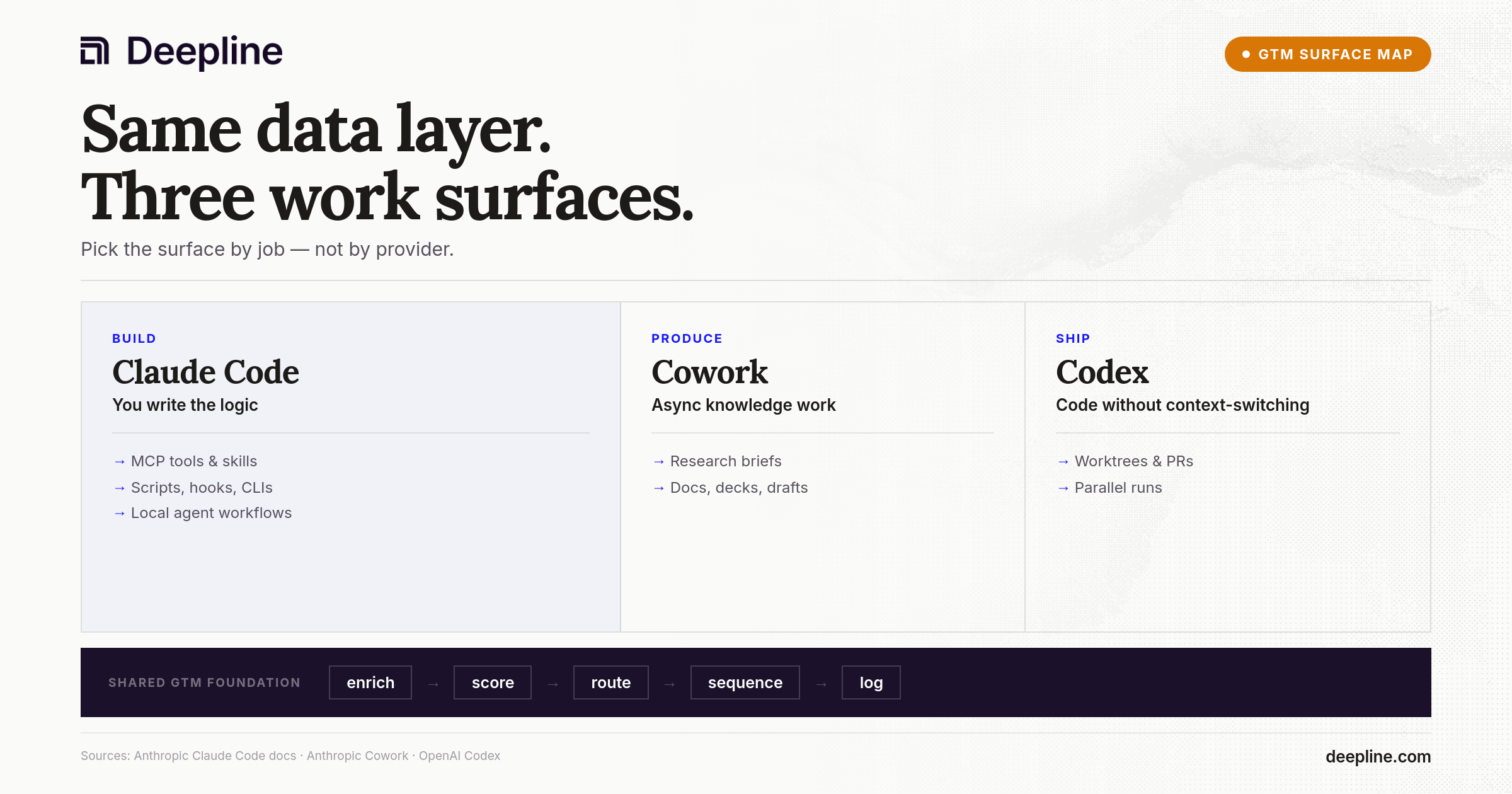
Diagram sources:
Anthropic Claude Code docs
,
Anthropic Claude Cowork
, and
OpenAI Codex app
.
What changed in the last 30 days
The market signal is sharper than the category language.
| Signal | Source | What it means for Deepline |
|---|---|---|
| OpenAI said Codex grew from more than 3 million weekly developers in early April 2026 to more than 4 million two weeks later. | OpenAI Codex enterprise update | Codex is a serious work surface for technical teams. |
| OpenAI's Codex app frames work around parallel agents, built-in worktrees, skills, automations, sandboxing, and review queues. | OpenAI Codex app | GTM workflows need APIs and testable actions if they want to run inside Codex. |
| Anthropic documents Claude Code across terminal, IDE, desktop, browser, Slack, CI, MCP, skills, hooks, routines, and multi-agent workflows. | Anthropic Claude Code overview | Claude Code is the stronger surface when GTM systems need tool access, repeatability, and project memory. |
| Claude Cowork is positioned for local files, apps, documents, research synthesis, and finished deliverables. Anthropic's enterprise materials add RBAC, spend caps, analytics, OpenTelemetry, and connector controls. | Anthropic Claude Cowork, Anthropic Cowork enterprise webinar | Cowork is a cleaner wedge for non-technical operators, but the data layer still has to be governed. |
| Reddit discussions show practitioners comparing Claude Code and Codex and asking when to use Claude Cowork instead of Claude Code. | Claude Code vs. Codex Reddit thread, Claude Code to Codex Reddit thread, Cowork vs. Claude Code Reddit thread | Buyers are already thinking in multi-agent setups. The durable layer is shared GTM systems, not one agent interface. |
| GTM Strategist / Growth Unhinged surveyed 200 GTM AI operators and reported that Claude Code and Cowork split operator usage almost evenly. | Growth Unhinged Claude for GTM report, GTM Strategist Claude for GTM pulse report | Content should compare jobs-to-be-done, not crown a winner. |
Quick comparison
| Tool | Best for | Source | What it needs from Deepline |
|---|---|---|---|
| Claude Code | Building GTM infrastructure, API workflows, skills, MCP integrations, scripts, and repeatable automations | Anthropic Claude Code overview, Claude Code MCP docs | Callable GTM tools, enrichment workflows, provider routing, test endpoints, and playbooks |
| Claude Cowork | Research synthesis, spreadsheet/deck/document output, local-file cleanup, operational task completion | Anthropic Claude Cowork | Simple task prompts that produce finished GTM artifacts from trusted data |
| OpenAI Codex | Repo-based implementation, code review, debugging, local environments, worktrees, and parallel engineering tasks | OpenAI Codex overview, OpenAI Codex worktrees | APIs and SDK-friendly GTM actions that Codex can wire into products and workflows |
| Cursor / IDE copilots | Human-in-the-loop coding inside an editor | Cursor docs, Cursor agent mode docs | Stable docs, examples, and callable APIs |
| Clay / Cargo / Databar | Visual GTM workflow building, tables, enrichment, agent/workflow surfaces, and GTM team collaboration | Clay homepage, Cargo docs, Databar Headless GTM article | Deepline can sit as the agent-callable systems layer or integrate with visual review surfaces |
What works best in Claude Code
Use Claude Code when the workflow needs to be engineered and reused.
Good GTM examples:
- Build a repeatable enrichment workflow with provider fallback logic.
- Turn a sales-call transcript pattern into a reusable lead-scoring script.
- Create a skill that researches accounts, enriches contacts, writes outputs, and pushes reviewed records to a CRM.
- Add tests or validation steps so the workflow fails loudly when data is missing.
- Connect GTM workflows to internal docs, Slack, Google Drive, CRMs, or custom tools through MCP and APIs.
This maps to Anthropic's own product shape: Claude Code reads codebases, edits files, runs commands, connects through MCP, uses CLAUDE.md, packages repeatable work as skills, and can run routines or multiple agents. Claude Code overview, Claude Code MCP docs
Claude Code can operate the GTM stack, but it needs GTM-native tools to call. Deepline provides the GTM systems layer inside Claude Code.
What works best in Claude Cowork
Use Cowork when the GTM job is operational and artifact-heavy.
Good GTM examples:
- Turn call transcripts into a customer-language brief.
- Assemble competitive research into a document or deck.
- Clean and organize files before a campaign planning session.
- Build a spreadsheet from source files and notes.
- Create a dashboard-style deliverable for a non-technical stakeholder.
Anthropic positions Cowork around autonomous knowledge-work tasks across local files, folders, and applications. Its examples include preparing documents, synthesizing research, extracting data from unstructured files, and organizing local files. Anthropic's enterprise rollout materials describe RBAC, spend caps, analytics, OpenTelemetry, and connector controls. Claude Cowork, Cowork enterprise webinar
The Deepline angle is simple: Cowork is where non-technical GTM users can request the deliverable, while Deepline provides the trusted GTM data and action layer behind it.
What works best in Codex
Use Codex when the GTM system is a software project.
Good GTM examples:
- Add a new API endpoint so an agent can call an internal GTM workflow.
- Build a data sync between Deepline, CRM, warehouse, and a product database.
- Review a GTM workflow implementation for bugs and edge cases.
- Run implementation tasks in parallel worktrees.
- Debug failing tests, migrations, or automation scripts.
OpenAI describes Codex as a coding agent for software development. The Codex app adds multiple agents, isolated worktrees, skills, scheduled automations, review queues, and work that can run for hours or days. OpenAI Academy lists sales-team use cases such as pipeline prioritization, meeting prep, forecast review, account-plan refresh, and stalled-deal diagnosis. OpenAI Codex overview, OpenAI Codex app, OpenAI Academy sales use cases
For Deepline, Codex is not a competing GTM product. It is another engineering surface that can build with Deepline. If your GTM team uses Codex, Deepline gives Codex a GTM toolbox instead of making it invent one-off scripts against CSV exports and half-documented APIs.
Use the right surface for the job
| GTM job | Best surface | Why |
|---|---|---|
| Build a reusable enrichment workflow with tests | Claude Code or Codex | The output should live in code, not a chat transcript. |
| Turn call transcripts into a customer-language brief | Cowork | The work is mostly file handling, synthesis, and formatting. |
| Add an API endpoint for a GTM action | Codex | The task is repo-bound implementation with reviewable diffs. |
| Package a repeatable outbound research process | Claude Code | Skills, MCP, hooks, and project instructions make the workflow reusable. |
| Prepare a forecast-risk memo from CRM exports, Slack, and call notes | Codex or Cowork | Codex is stronger if the data lives in files/repos; Cowork is stronger when the operator wants a finished document. |
| Inspect rows before pushing to CRM | Deepline UI plus agent-callable actions | Humans need review, but agents need the same action layer underneath. |
Where "anything else" fits
Cursor and IDE copilots
Cursor is best when a human still wants to drive the coding loop inside an editor. It is useful for building Deepline-connected GTM apps, but it is less of a category wedge for "agent-run GTM systems" than Claude Code or Codex.
Clay
Clay's homepage positions it around AI agents, enrichment, intent data, data providers, CRM enrichment, and GTM workflows. That makes it a useful comparison point, but Deepline is not only a table alternative. Clay homepage
The stronger counterposition: Clay made GTM workflows visual. Deepline makes GTM workflows agent-callable.
Cargo
Cargo's docs describe an AI workforce for GTM with tools, agents, plays, models, files, warehouse, and revenue-organization workflows. Deepline differentiates on developer and agent ergonomics: APIs, CLI, SDK, test endpoints, reproducibility, and inspectable workflow runs. Cargo docs
Databar and headless GTM
Databar has named the "headless GTM" wedge as terminal or agent-driven GTM with MCP, SDK, or API-connected tools. Do not copy vendor claims. Use the market signal: buyers are starting to ask whether GTM can run without tab-switching through dashboards. Databar Headless GTM article
Deepline's answer: yes, but headless GTM only works when the data and action layer is reliable enough for agents.
Deepline point of view
The category is not "which coding agent wins GTM." The category is "what GTM systems layer do agents need?"
Claude Code, Cowork, Codex, Cursor, and browser agents are interfaces. Clay, Cargo, Databar, ZoomInfo, CRMs, warehouses, and sending tools are surfaces or sources. The useful layer across them is an agent-callable GTM system:
- Enrichment workflows agents can call.
- Waterfalls and provider routing agents do not need to reinvent.
- Test endpoints so agents can validate behavior.
- Reusable plays for prospecting, routing, research, and account intelligence.
- Observability so teams can trust what happened.
- Human review where GTM actions are consequential.
That framing also keeps the copy honest. Claude Code and Codex are changing quickly. Cowork is changing quickly. A GTM systems layer should not bet the category on a single interface. It should make the GTM work portable across all of them.
Sources
- Anthropic Claude Code overview
- Anthropic Claude Cowork
- Anthropic Cowork enterprise webinar
- OpenAI introducing the Codex app
- OpenAI scaling Codex to enterprises worldwide
- OpenAI Academy: how sales teams use Codex
- OpenAI Codex overview
- OpenAI Codex CLI
- OpenAI Codex worktrees
- Growth Unhinged Claude for GTM report
- GTM Strategist Claude for GTM pulse report
- Reddit: Claude Code vs Codex discussion
- Reddit: moving from Claude Code to Codex
- Databar Headless GTM article
- Clay homepage
- Cargo docs