

How do I find and validate emails with Claude Code?
In Claude Code, type:What does the email waterfall with validation do step by step?
The cost-aware waterfall runs in three phases: pattern validation, paid provider fallback, and deliverability verification. For example, a lookup that validates the first pattern uses one 0.09-credit validation. The paid fallback only fires when no pattern validates.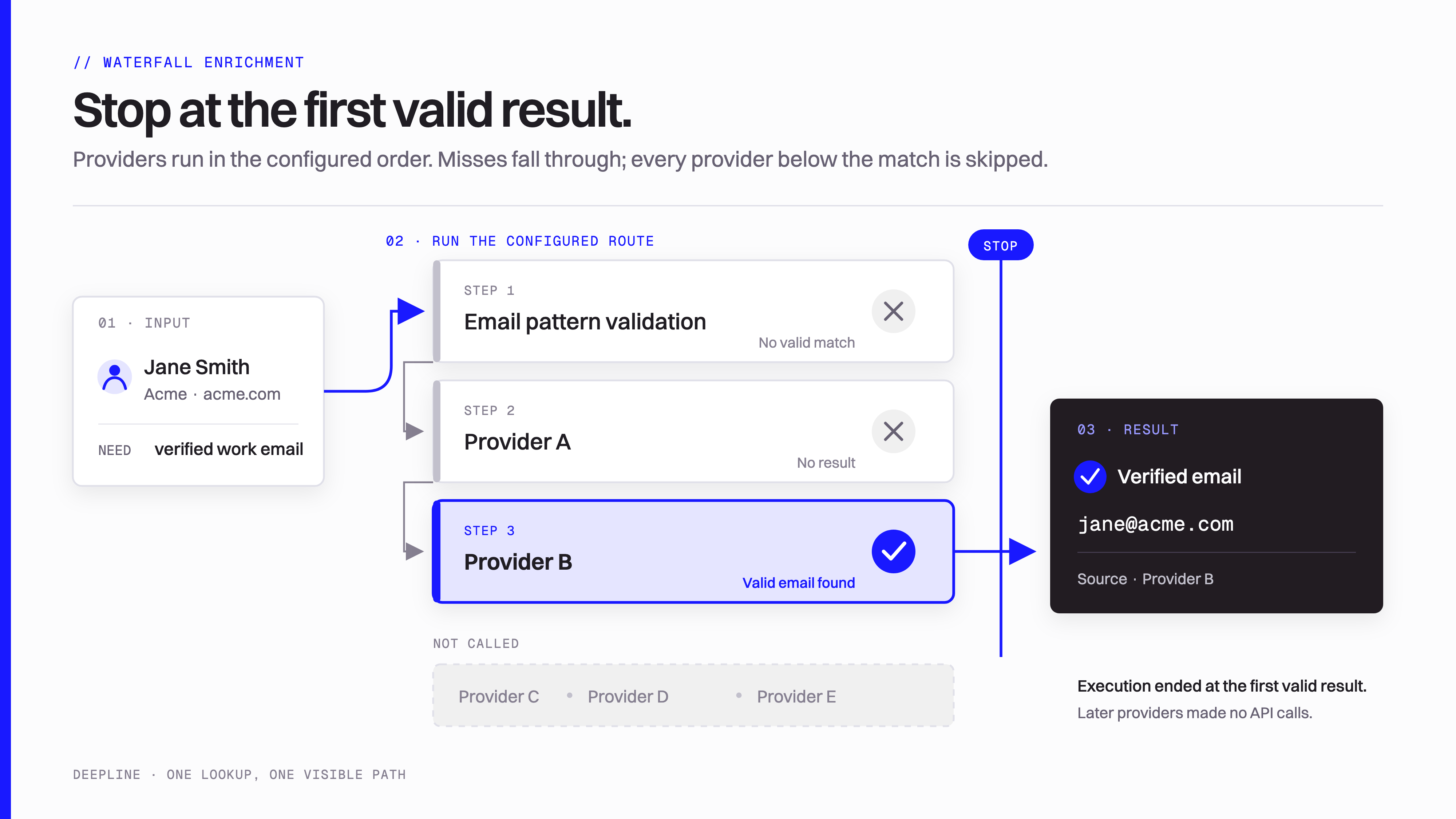
Example of the shared waterfall routing pattern: providers run in the configured order, misses fall through, and later providers are skipped after the stopping condition is met.
1
Try email patterns
Deepline generates likely deterministic patterns, such as first.last@domain
and firstlast@domain, and validates them with LeadMagic.
2
Fall through to paid providers if needed
If no pattern validates, the configured finder waterfall runs. Inspect the
live play for the current provider order.
3
Optionally validate deliverability
Chain
zerobounce_validate after the waterfall for bounce-risk scoring —
checking deliverability, not just syntax.4
Return verified email with status
The email is returned with a deliverability status: valid, catch-all, or
invalid.
Which providers does the waterfall try and in what order?
Thename_and_domain_to_email_waterfall runs in three configured phases:
Phase 1 — Email patterns:
- Generate configured deterministic patterns such as
first.last@domain - Validate each candidate with LeadMagic
- If one validates, skip paid providers entirely
zerobounce_validate on the found email for bounce-risk scoring
These are standalone tool prices, not a total-run quote or a claim about
provider order. Actual cost depends on which steps execute and whether you use
managed billing or BYOK.
CLI command
CLI command
Related tasks: Find Work Email | Find Personal Email | Prospecting and multi-signal outreach
Frequently Asked Questions
What is the difference between Find Work Email and Email Waterfall with Validation?
Find Work Email finds an email using a configured provider waterfall. Email Waterfall with Validation adds two things: low-cost email pattern matching first, and optional ZeroBounce deliverability verification. Use Find Work Email for speed. Use Email Waterfall with Validation when you need deliverability guarantees.How much does the email waterfall with validation cost?
For example, a first-pattern match uses one 0.09-credit LeadMagic validation. As a standalone tool-rate example, a successful DropLeads Email Finder result costs 0.26 credits; this does not imply where DropLeads appears in the active play. Actual cost depends on the steps that execute and any optional ZeroBounce verification. The cost-aware approach saves the most money on domains with predictable email patterns.Can I find and validate emails in bulk from a CSV?
Yes. type/deepline-gtm find and validate emails for leads.csv and Deepline reads your column headers (first_name, last_name, domain), selects the cost-aware waterfall, and enriches every row with a verified email and deliverability status. Always pilot with 3-5 rows first.